
When people ask what is 24 hour translation, they are usually asking a more practical question: “Can I get this translated properly, certified if needed, and ready before my deadline?” That is the real issue behind most urgent enquiries. You may be preparing a visa file, sending academic records, responding to a legal deadline, or trying to submit business documents without delay. In each case, speed matters, but so does acceptance.
A true 24 hour translation service is not just fast typing. It is a deadline-led workflow built to move eligible documents through assessment, translation, review, certification, and delivery without wasting time. Done properly, it gives you a realistic route to a fast submission. Done badly, it creates false urgency, weak quality control, and expensive rework.
That is why the most useful way to explain 24 hour translation is not as a promise that “anything can be done in a day,” but as a professional urgent translation service designed for documents that can genuinely be completed within that timeframe without cutting corners.
In plain English:
24 hour translation is a professional translation service for time-sensitive documents that can be translated, checked, and delivered within roughly one day, often with priority handling and certified options where required.
What You Usually Get With 24 Hour Translation
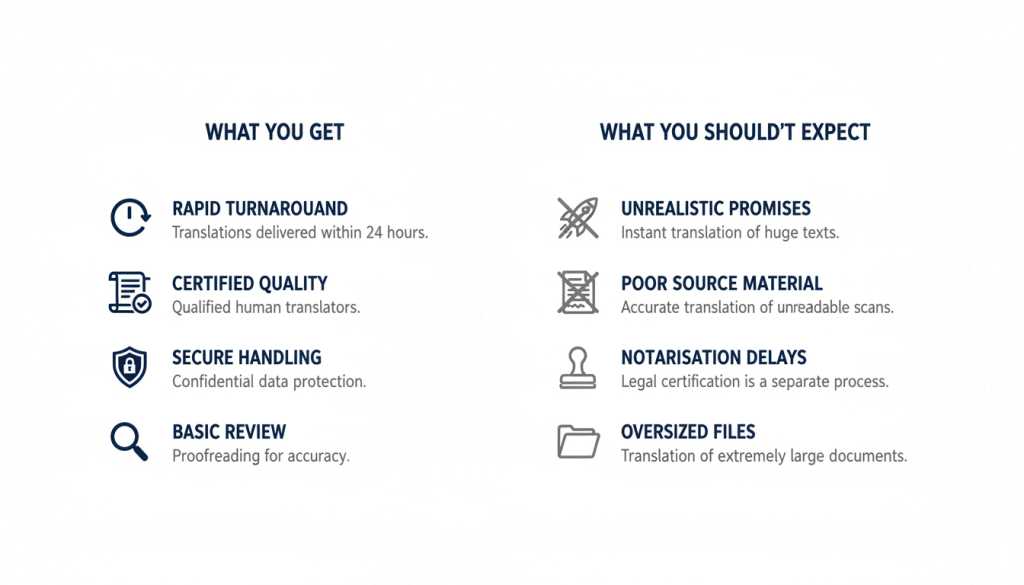
A strong 24 hour certified translation or urgent translation service usually includes far more than translation alone.
Priority assessment from the start
The first step is deciding whether the job is actually suitable for a fast turnaround. A reliable provider does not simply accept the file and hope for the best. They check:
- document type
- length and complexity
- image quality
- language pair
- certification needs
- formatting requirements
- deadline realism
This first check is one of the biggest differences between a professional urgent service and an overpromised one.
Fast translator matching
Urgent work still needs the right linguist. Legal, academic, immigration, and financial texts all carry different risks. Good fast translation turnaround depends on matching the file to someone who understands the subject matter, not just the language.
Review before delivery
Speed should come from workflow design, not skipped checks. A proper urgent process still includes a review stage for completeness, terminology, names, dates, and submission-readiness.
Certification where required
Many time-sensitive jobs are not only urgent, but official. That means the translated document may need to be presented with a certification statement and professional presentation suitable for the authority receiving it.
Digital delivery
Most urgent jobs are delivered digitally first, because that is what saves time. If hard copies, notarisation, apostille, or courier handling are needed, that becomes part of the planning conversation rather than an afterthought.
What You Shouldn’t Expect From 24 Hour Translation
This is where many pages on the topic stay vague. They talk about speed, but not about limits. The most useful expectation-setting is often about what not to assume.
Not every file is a 24-hour file
A short birth certificate and a dense multi-page shareholder agreement are not the same job. A clean academic transcript and a blurred handwritten court bundle are not the same job. “Urgent” does not erase complexity.
Fast does not mean rushed rewriting
A professional urgent translation service is meant to produce an accurate translation, not endless rounds of editing, rewriting, redesign, or style experimentation.
Certification is not the same as notarisation or apostille
These are different steps. A certified translation may fit a fast turnaround more easily than a file that also needs third-party legalisation steps.
Poor source files do not become simple because the deadline is tight
Bad scans, cropped pages, hidden stamps, handwritten notes, and missing pages slow everything down. The fastest jobs are usually the cleanest ones.
A 24-hour turnaround is not a guarantee that every part of your wider process is complete
Translation may be done within the day, but your wider submission may still depend on print requirements, courier timing, authority opening hours, or extra authentication steps.
The Real Factors That Decide Whether a Fast Translation Turnaround Is Possible
If you want the honest answer to “what is 24 hour translation,” this is the part that matters most. A 24-hour window is shaped by a few practical variables.
1. Document length
Short, self-contained documents are the best fit. These include certificates, letters, short statements, and compact records. Longer files can still move quickly, but only if the text is straightforward and the workflow is planned carefully.
2. Document complexity
A one-page certificate with predictable fields is very different from a financial statement full of tables, notes, and specialised terminology. Complexity is not only about page count. It is about what the translator must decode, verify, and present accurately.
3. Language pair
Some language pairs are easier to place quickly than others. Common combinations often move faster than rare or highly specialised ones.
4. Submission purpose
A translation for internal reference is not the same as a translation for a visa application, court filing, university submission, or overseas authority. Official use raises the importance of format, certification, and completeness.
5. Formatting needs
If the document includes tables, stamps, seals, signatures, side notes, or unusual layouts, the presentation stage matters more. That does not always rule out fast delivery, but it affects the workload.
6. Extra services
Hard copies, sworn routes, notarisation, apostille, legalisation, or courier dispatch can all extend the process beyond the translation itself.
A Practical Reality Check: Which Documents Fit 24 Hours Best?
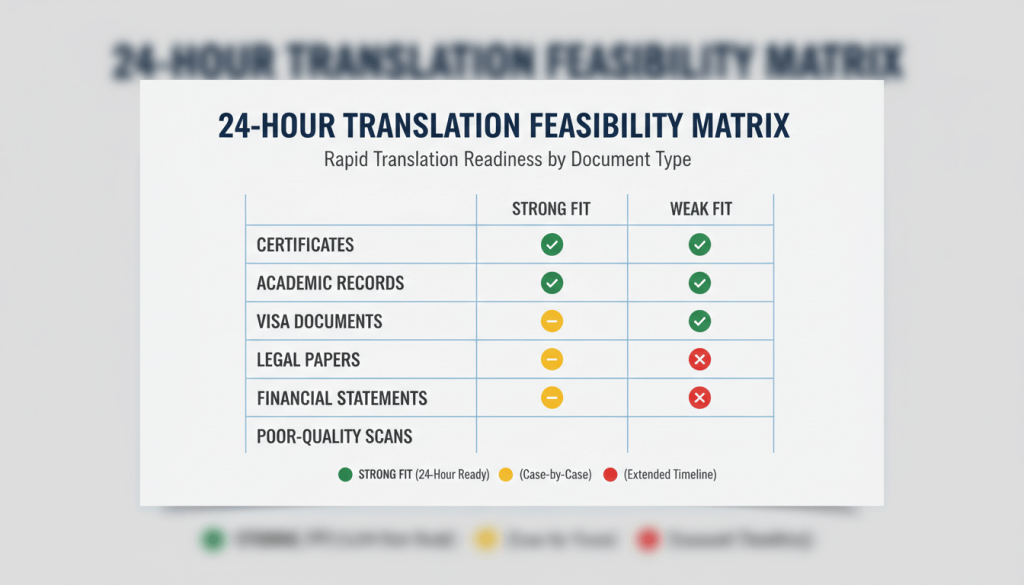
This is where clients save the most time: knowing which jobs are naturally suited to urgent handling and which ones need a longer plan.
| Document Type | Fit for 24 Hours | Why |
| Birth certificates, marriage certificates, death certificates | Strong fit | Short, structured, and usually straightforward to certify |
| Academic transcripts and diplomas | Strong to moderate fit | Often suitable if scans are clear and terminology is standard |
| Visa support documents such as letters, bank summaries, proof of address | Moderate to strong fit | Good fit when readable and not too high in volume |
| Employment letters and simple business documents | Moderate to strong fit | Usually manageable if formatting is not heavy |
| Contracts, court documents, affidavits | Moderate fit | Possible, but legal terminology and risk level require careful checking |
| Financial statements with dense tables and notes | Moderate to weak fit | Accuracy and formatting demand more time |
| Handwritten, marked-up, or poor-quality scans | Weak fit | Review time rises quickly and missing detail becomes a serious risk |
| Large multi-document bundles | Depends on scope | Often better handled through staged delivery or prioritisation |
What 24 Hour Certified Translation Actually Means
The phrase 24 hour certified translation is often misunderstood. It does not just mean “translated in 24 hours.” It means the service is fast and the output is prepared in a form that can be used for official purposes.
That usually means the provider is thinking about:
- whether the full document must be translated
- whether stamps, seals, notes, and visible marks must be reflected
- whether the certification wording is appropriate
- whether names, dates, and document references are consistent
- whether the final file looks ready for submission
This matters because an urgent official translation is not useful if it arrives quickly but creates questions when submitted.
24 Hour Translation vs Same-Day Translation vs Standard Turnaround
These three are often used interchangeably, but they are not quite the same.
24 hour translation
Usually means the work is scheduled to be completed within roughly one day. This is often the best balance between urgency and quality for eligible documents.
Same-day translation
Usually refers to work completed on the same calendar day, often within working hours. This can be ideal for very short files, but it is a narrower window and usually a tighter workflow.
Standard turnaround
Better suited to larger files, more complex formatting, less common language pairs, or projects needing additional review stages.
The right choice depends less on how urgent you feel and more on how suitable the file is for accelerated handling.
Why Quality Control Matters Even More on Urgent Jobs
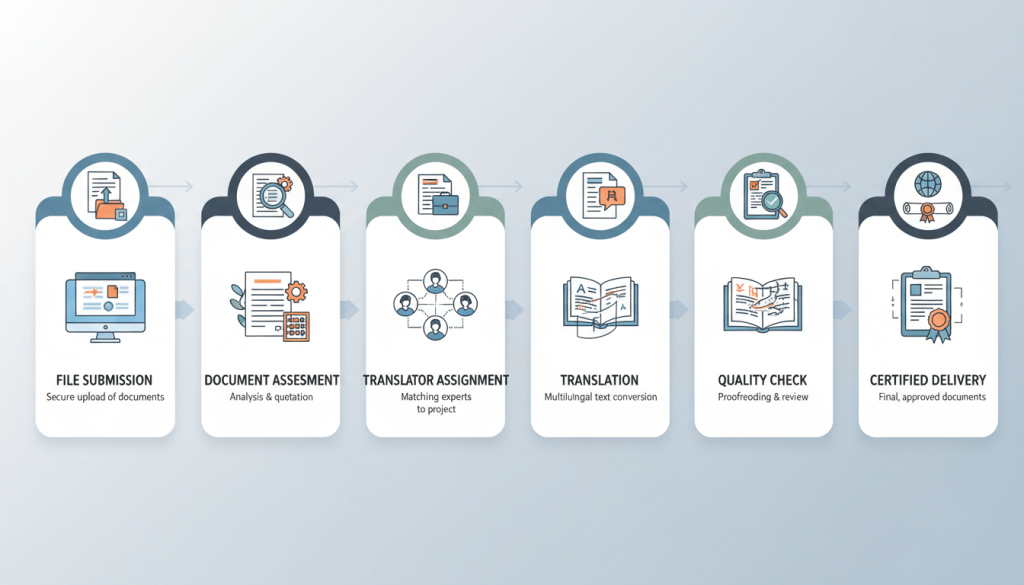
Fast work is where weak processes show up first. That is why urgent translation service should be built around control points, not shortcuts.
A sensible quality workflow for urgent jobs includes:
Translator selection
The file needs the right specialist, not just the next available person.
Completeness check
Nothing important should be silently skipped, especially in official documents.
Terminology consistency
Names, places, company references, and repeated terms must stay aligned across the whole file.
Certification review
If the translation is for official use, the final presentation matters just as much as the wording.
Delivery check
The wrong file format, missing page, or incomplete attachment can waste the time you were trying to save.
A fast translation turnaround should feel organised, not frantic.
What a Good Urgent Translation Service Will Tell You Up Front
The best urgent providers do something many weak providers avoid: they tell you the truth before you pay.
They should be able to tell you:
- whether the file genuinely fits a 24-hour window
- whether a certified route is needed
- whether poor scan quality could slow the job
- whether a staged delivery makes more sense
- whether extra legalisation steps sit outside the translation window
- whether the authority is likely to expect a full translation rather than selected extracts
That kind of clarity is often more valuable than a dramatic promise.
What a 24 Hour Translation Service Is Best For
A strong urgent translation service is usually a good fit for people facing real submission deadlines, not vague future tasks.
Immigration and visa submissions
When a deadline is close, fast handling of certificates, statements, and supporting documents can keep the application moving.
Academic deadlines
Students and professionals often need transcripts, diplomas, or letters prepared quickly for universities, recognition bodies, or application windows.
Legal matters
Court directions, solicitor requests, and contractual timelines often leave little room for delay, but accuracy remains non-negotiable.
Business and corporate needs
Tenders, incorporation papers, shareholder documents, financial records, and compliance materials sometimes need rapid delivery to avoid bottlenecks.
Original Insight: The Best 24-Hour Jobs Are Usually Clear, Complete, and Contained
Here is the simplest way to judge whether your job is a natural fit for 24 hour translation:
- Clear means the scan is readable
- Complete means all pages are present
- Contained means the scope is defined and not constantly changing
If one of those is missing, the job becomes slower than it looks.
This is why the real secret behind fast translation turnaround is not speed alone. It is reducing avoidable friction before the translator even starts.
How to Get Your Translation Faster Without Increasing Risk
If your deadline is tight, these small steps make a real difference.
Send the cleanest file you have
Use a proper scan if possible. Avoid cropped photos, glare, shadows, and cut-off text.
State the exact deadline
“Urgent” is helpful, but “needed by 3pm tomorrow for a visa submission” is much more useful.
Say where the translation will be submitted
The receiving authority affects certification, formatting, and presentation decisions.
Mention whether hard copies or extra authentication are needed
Do not wait until the translation is done to mention notarisation, apostille, or courier dispatch.
Keep the scope stable
Late file changes and extra pages slow urgent jobs more than most people expect.
What You Should Ask Before Choosing a Provider
Before ordering a 24 hour certified translation, ask these questions:
- Is my file genuinely suitable for 24-hour delivery?
- Will the translation be prepared for official submission if needed?
- Are stamps, seals, notes, and formatting handled properly?
- What is included in the review process?
- Is delivery digital, hard copy, or both?
- Are notarisation or apostille steps separate from the translation timeline?
- What happens if the source file quality causes issues?
A provider who answers clearly is usually safer than one who only promises speed.
Why This Matters More Than Ever
People rarely search for “what is 24 hour translation” out of curiosity alone. They search it when timing is already a problem. That means the content they need is not a vague description of a service. They need a practical decision framework.
They need to know:
- whether the job fits the timeline
- what level of review to expect
- whether certification is possible
- what may delay delivery
- what extra steps may sit outside the core translation window
That is the difference between useful guidance and generic sales copy.
What 24 Hour Translation Means at 24 Hour Translation
At 24 Hour Translation, the focus is not on making unrealistic promises. It is on giving you a fast, submission-ready service for documents that can genuinely be handled within the timeframe.
That means clear file assessment, deadline-led handling, professional translation, official certification where required, and careful review before delivery.
If your document can be done safely within 24 hours, that should be clear from the start. If it cannot, you should be told that early and offered the most realistic route forward.
That is what a trustworthy urgent translation service should look like.
If you are working to a real deadline, upload your file and get a clear answer on turnaround, certification, and delivery before you commit.
Frequently Asked Questions
What is 24 hour translation?
24 hour translation is a professional service for eligible documents that need to be translated, checked, and delivered within roughly one day. It is typically used for urgent personal, legal, academic, immigration, and business submissions.
Can I get a 24 hour certified translation?
Yes, many short and medium-length official documents can be handled as a 24 hour certified translation, provided the file is readable, the language pair is available, and the scope is realistic for the deadline.
Does fast translation turnaround reduce quality?
It should not. A professional urgent translation service speeds up the workflow through priority handling and efficient coordination, not by skipping review, certification, or accuracy checks.
What documents are best suited to an urgent translation service?
Short certificates, transcripts, letters, visa support documents, and other clear, self-contained files are usually the best fit. Dense legal bundles, poor-quality scans, and large formatted reports often need more time.
Can notarised or apostilled translations be completed in 24 hours?
Sometimes the translation itself can be completed quickly, but notarisation, apostille, legalisation, and courier steps may extend the overall timeline. These should be discussed separately at the quoting stage.
How do I improve the chances of getting my translation back in 24 hours?
Send a clean complete scan, state the deadline clearly, explain where the translation will be submitted, and mention any certification or hard-copy requirements from the start.