A digital certified translation is often the fastest and most practical option in the UK. For many online and email-based submissions, a properly prepared PDF is exactly what the process is built around. But “digital” is not the same as “automatically accepted”. What matters is whether the receiving authority can verify the translation, whether the submission route is digital in the first place, and whether the case also requires a hard copy, notarisation, or apostille. Current UK guidance is clear on the underlying rule: non-English documents generally need a full translation with specific certification details, many visa and sponsor routes accept scans or digital copies, visitor guidance says digital images should be taken from originals where possible, HM Passport Office is more restrictive with digital copies, and e-Apostilles only work in certain circumstances. (GOV.UK)
The practical takeaway is simple: a certified PDF is usually a format decision, not a lower standard. If the translation is complete, professionally certified, readable, and matched to the authority’s submission method, it can be the right answer. If the authority wants an original, a bound set, a notarised pack, or an apostilled document, PDF alone is not enough. That is where many avoidable rejections start.
What a digital certified translation actually is
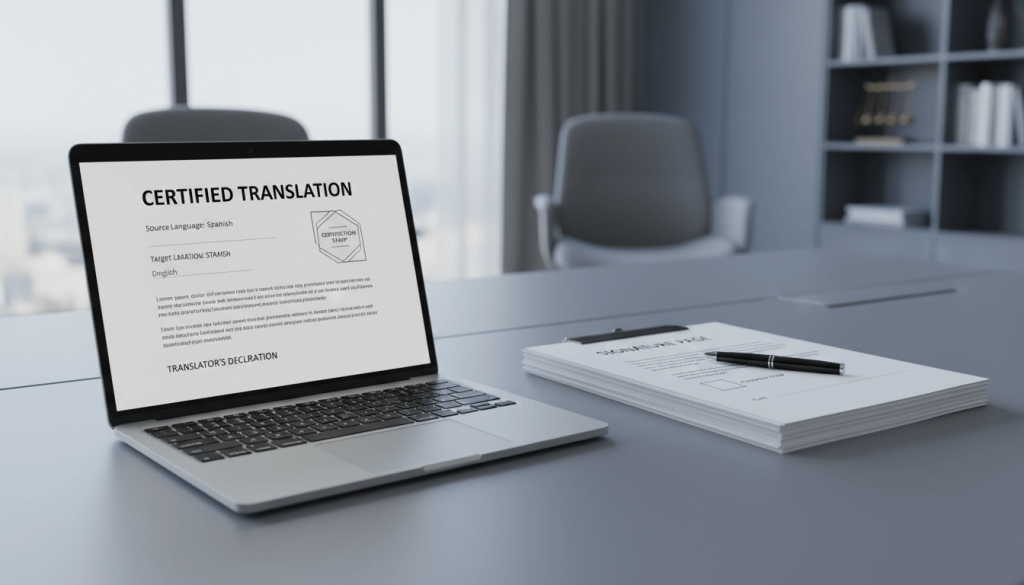
A digital certified translation is a certified translation delivered as a PDF, usually by email. In a well-prepared version, you typically receive:
- the translation itself
- a certification statement
- the translator’s or translation company’s identifying details
- signature details
- the date of certification
- an optional copy of the source document in the same file
For many clients, this is the most useful format because it is ready to upload, easy to forward, and quick to store. It also reduces delay when the submission route is an online portal, visa account, university admissions system, employer onboarding process, or email submission.
What makes it “certified” is not the file extension. It is the certification and the ability of the receiving body to verify what they are looking at.
The rule that matters more than “wet ink”
The biggest mistake people make is focusing on whether a stamp is printed in ink or shown on a screen. In most real-world cases, the stronger question is this:
Can the receiving body identify the translation, match it to the original, and verify who certified it?
That is why a clean, well-structured certified PDF is often accepted while a messy hard copy can still cause problems.
A useful way to think about it:
- Format is how the translation is delivered.
- Certification is what gives the translation official value.
- Acceptance depends on the authority, the process, and the document purpose.
What a UK-ready certified translation PDF should include
If you want the safest possible digital submission, the PDF should be built around the details UK authorities commonly expect on certified translations:
- confirmation that the translation is accurate
- date of translation or certification
- translator’s full name
- signature
- contact details
- where relevant, company details or translator credentials
This mirrors the certification details repeatedly required in current UK immigration guidance. (GOV.UK)
A stronger digital pack also includes:
- clear page numbering
- the original document attached before or after the translation
- notes for stamps, seals, handwritten text, or illegible areas
- consistent spelling of names across all pages
- a file name that makes sense, such as Birth-Certificate-Certified-Translation-English.pdf
When a digital certified translation is usually accepted
In practice, certified PDFs are often the safest and quickest choice when the receiving process is already digital.
Common green-light situations
Online visa and immigration applications
If the application is submitted online and documents are uploaded digitally, a certified PDF is usually the practical format. UK visitor guidance explicitly says digital images should be taken of original documents where possible, and non-English documents must be accompanied by a full translation with the required certification details. Family and work visa guidance also requires certified translations for documents not in English or Welsh. (GOV.UK)
Sponsor licence and business compliance submissions
For sponsor licence applications, GOV.UK states that supporting documents can be scanned or photographed and sent electronically, and the guidance also recognises electronic copies of original documents. That makes digital certified translations a natural fit for this route. (GOV.UK)
University, employer, and private-sector requests
Where the receiving team asks for documents by email or portal upload, a certified PDF is often the cleanest solution. The main risk here is not the PDF itself, but poor presentation: missing certification wording, weak scans, or mismatched names.
When PDF-only is not the safe option
This is where many clients get caught out. A digital certified translation may still be perfectly prepared and still be the wrong format for the job.
Common amber or red-flag situations
The authority asks for an original or certified hard copy
If the instruction says “original”, “wet signature”, “wet stamp”, “posted original”, or “certified hard copy”, do not rely on PDF alone.
The case involves notarisation or apostille
If the end use requires notarisation or legalisation, standard digital delivery is not enough by itself. The FCDO now offers e-Apostilles, but only where the underlying PDF has been electronically signed by a UK notary or solicitor, and some document categories are excluded from the e-Apostille route. (GOV.UK)
Passport, registry, or original-document checking
HM Passport Office guidance is noticeably more cautious. It says digital documents and photocopies are not usually accepted except in certain circumstances. That does not mean every passport-related translation must be paper-only, but it does mean you should never assume a PDF will be enough without checking the exact requirement. (GOV.UK)
Overseas authorities with formal presentation rules
Embassies, civil registries, courts, or overseas ministries may ask for:
- a bound translation set
- a translator’s original signature
- notarisation
- apostille
- in-person presentation
- a translation physically attached to the source copy
If any of that appears in the instruction, a PDF should be treated as a working copy, not the final answer.
A simple acceptance matrix
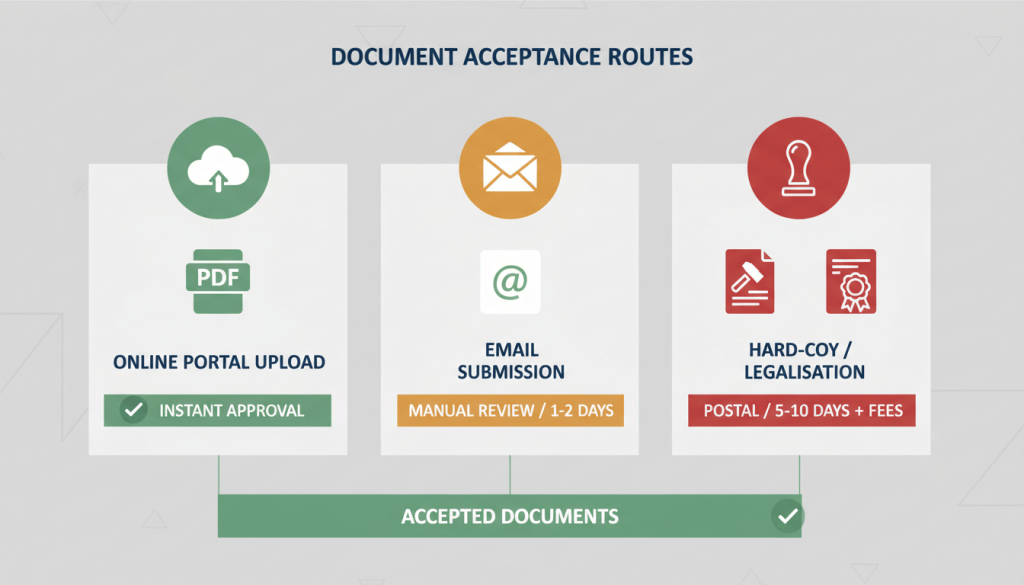
| Submission type | Is a digital certified translation often suitable? | Safer approach |
| UK online visa application | Usually yes | Upload a clear source scan and a properly certified PDF |
| Email-based official submission | Usually yes | Use one neat PDF with logical file naming |
| Sponsor licence supporting docs | Usually yes | Follow the requested file format and include certification clearly |
| University or employer onboarding | Often yes | Confirm if they want PDF only or PDF plus hard copy |
| HM Passport Office or identity-heavy checks | Sometimes | Check first; do not assume PDF-only |
| Court bundle or embassy filing | Mixed | Ask whether they require bound or original hard copy |
| Notarised or apostilled use abroad | Not by itself | Confirm whether notarisation, paper apostille, or e-Apostille is required |
The real risks with digital certified translations
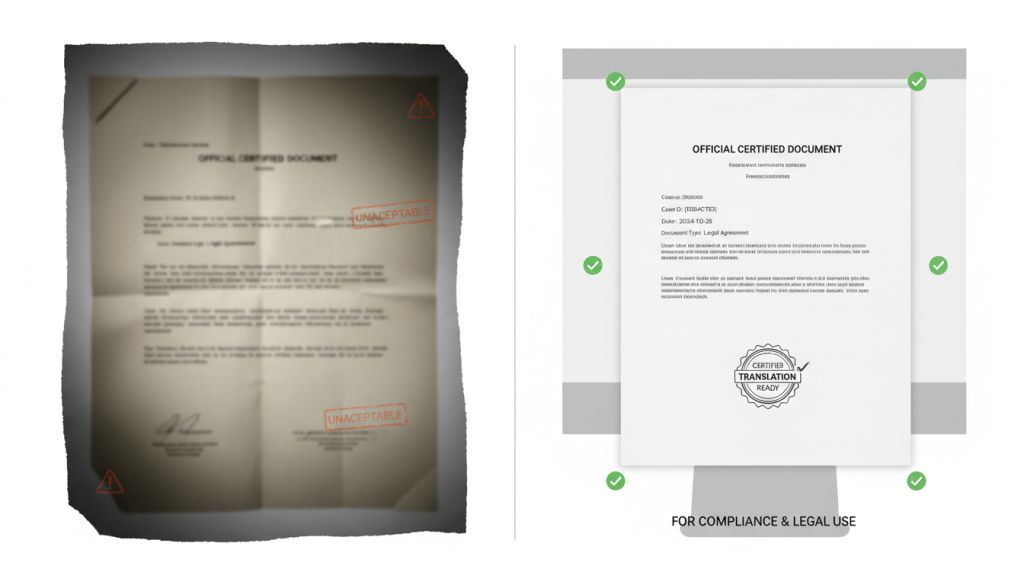
The risk is rarely “because it’s a PDF”. The risk is usually one of these:
1. The scan is poor
If the source document is blurry, cropped, shadowed, or photographed at an angle, the translation may still be accurate but the authority may reject the pack because the underlying document is not clearly readable.
2. The certification is incomplete
Missing signature, no date, no contact details, vague wording, or no clear link to the original document are all common causes of delay.
3. Names do not match supporting records
This is especially important for passports, bank statements, academic transcripts, and visa files. Transliteration issues can create avoidable doubt.
4. The file looks easy to tamper with
A weak PDF layout, floating images, inconsistent fonts, or a badly placed stamp graphic can make the translation look less trustworthy than it should.
5. The client orders the wrong level of service
A certified translation, a notarised translation, and an apostilled translation are not interchangeable. Ordering the cheapest or fastest option without checking the requirement can cost more later.
Best practice: how to order a digital certified translation that is more likely to be accepted

Start with the source document, not the translation
Send a scan or photo of the original document, not a copy of a copy. This matters because current UK visitor guidance specifically points toward digital images of originals where possible. (GOV.UK)
Ask one direct question before ordering
Use this wording:
Do you accept a digitally delivered certified translation in PDF, or do you require a posted original hard copy?
If relevant, add:
Does it also need notarisation or apostille?
This one step prevents most expensive format mistakes.
Request a complete pack, not just “the translation text”
The safest digital delivery usually includes:
- source document copy
- full translation
- certificate page
- notes for stamps, seals, signatures, or handwritten entries
Keep layout and pagination clean
For formal submissions, presentation matters. Tables, seals, annotations, page numbers, and headings should be easy to follow. A clear PDF looks more credible and is easier for an officer, caseworker, admissions team, or administrator to review.
Keep a hard copy option available
Even when PDF is enough, situations change. A caseworker may request a paper copy later. A university might ask for originals after a provisional decision. An overseas authority may accept email first and hard copy afterward.
That is why a provider who can supply both digital delivery and posted certified copies is often the safer choice than a PDF-only service.
A practical way to decide what you need
Use this three-part check:
If the process is digital
A certified PDF is often the first choice.
If the instruction mentions “original”, “wet ink”, “notary”, or “apostille”
Do not stop at PDF.
If the authority is overseas
Assume nothing until the receiving body confirms the format.
That approach is more reliable than general internet advice because it follows the real source of truth: the receiving authority’s own submission rules.
Examples
Example 1: UK visa application with civil documents
A client uploads a birth certificate, marriage certificate, and bank statements to an online visa account. A properly certified PDF is usually the right format because the entire route is digital.
Example 2: Overseas marriage registration
A client needs a translated UK document for use abroad. The registry says the pack must be notarised and apostilled. A standard certified PDF alone is not enough.
Example 3: Court-related or formal legal filing
The translation may be reviewed digitally, but the bundle may still need consistent formatting, source-copy attachment, or a physical set depending on the procedure. This is where checking presentation rules early saves time.
What to ask your translation provider before you pay
Before placing the order, ask:
- Will the certified PDF include the source document, translation, and certificate?
- Will the certificate show full name, signature, date, and contact details?
- Can you arrange hard copies if the authority asks for them later?
- Can you advise if the case sounds like it needs notarisation or apostille instead?
- Will names, dates, reference numbers, and stamps be checked carefully?
- Can you preserve layout where tables, seals, or official formatting matter?
If the answers are vague, the risk of delay goes up.
Why this matters for urgent applications
Digital certified translations are popular because they remove postage delays. For urgent immigration, legal, academic, and business deadlines, that speed matters. But speed only helps if the first version is the right version.
24 Hour Translation’s current site messaging already aligns well with this need: it promotes certified translations prepared for UK authorities and institutions, offers 24-hour, 12-hour, and same-day turnaround options, includes digital delivery, and states that certified hard copies can also be arranged if required. (24 Hour Translation)
That combination is exactly what many clients need: a fast certified PDF when digital submission is accepted, plus a hard-copy route when the authority asks for more.
The safest conclusion
A digital certified translation in the UK is often accepted when the receiving body works digitally and the translation is properly certified. It becomes risky when people assume that “PDF” and “official” mean the same thing in every context.
They do not.
The safer rule is this:
Match the translation format to the authority’s process.
If the authority receives documents online, a certified PDF is often the right answer. If the authority wants originals, notarisation, apostille, or bound hard copies, treat digital delivery as only part of the job.
If you need a fast answer on your own documents, upload your file, say who requested it, and ask for the format to be confirmed before work starts. That is the quickest route to a translation you can actually use.
FAQs
Are digital certified translations accepted in the UK?
Often, yes. A digital certified translation UK submission is commonly accepted where the receiving process is online or email-based. The key issue is whether the receiving body can verify the translation and whether it has asked for a hard copy, notarisation, or apostille instead.
Is a PDF certified translation enough for UKVI or Home Office use?
In many digital immigration routes, a PDF certified translation is suitable because the application itself is submitted online and the documents are uploaded digitally. The translation still needs the proper certification details and must match the source document clearly. (GOV.UK)
Can I print a digital certified translation and use it as an original?
Sometimes, but not always. Some organisations are happy with a printed PDF certified translation. Others specifically want a hard copy issued and signed by the provider. If the instruction says “original”, confirm before relying on a printout.
When do I need a hard copy instead of email delivery?
You should expect a hard copy to be safer when the authority asks for a wet signature, original stamp, bound set, notarisation, apostille, or physical presentation.
Do digital certified translations work for apostille?
Not by themselves. If apostille is required, you need to check whether the case qualifies for an e-Apostille or whether a paper-based route is required. The e-Apostille route depends on electronically signed PDFs from a UK notary or solicitor and is not available for every document type. (GOV.UK)
What should a certified translation PDF include?
At minimum, it should include the translation, a certification statement confirming accuracy, the date, the translator’s full name, signature details, and contact details. A stronger pack also includes the source document and clear notes for stamps, seals, or handwritten text. (GOV.UK)