If you are preparing a visa or immigration application, the UKVI translation requirements are one of the easiest details to underestimate. A document can look perfectly professional and still create a problem if the translation is incomplete, the certificate wording is weak, or the translator cannot be verified properly. For many applicants, the issue is not the language itself. It is the submission format.
This guide explains what UKVI usually expects, which documents commonly need certified translation for UKVI, what the Home Office translation rules actually mean in practice, and how to run a simple official submission checklist before you upload anything.
Need a UKVI-ready translation without the guesswork?
Send your file to 24 Hour Translation and get it checked for certification wording, document type, and submission readiness before you apply.
The practical rule most applicants should follow
Treat every non-English or non-Welsh supporting document as if it needs:
- The original document or a clear scan of it
- A full English translation
- A certification statement confirming accuracy
- The translation date
- The translator’s full name
- The translator’s signature, or an authorised company sign-off where appropriate
- Contact details that make the translator or company easy to verify
- Credentials added where route-specific rules or in-country applications make that advisable
That approach is safer than trying to do the bare minimum.
The 60-second UKVI checklist
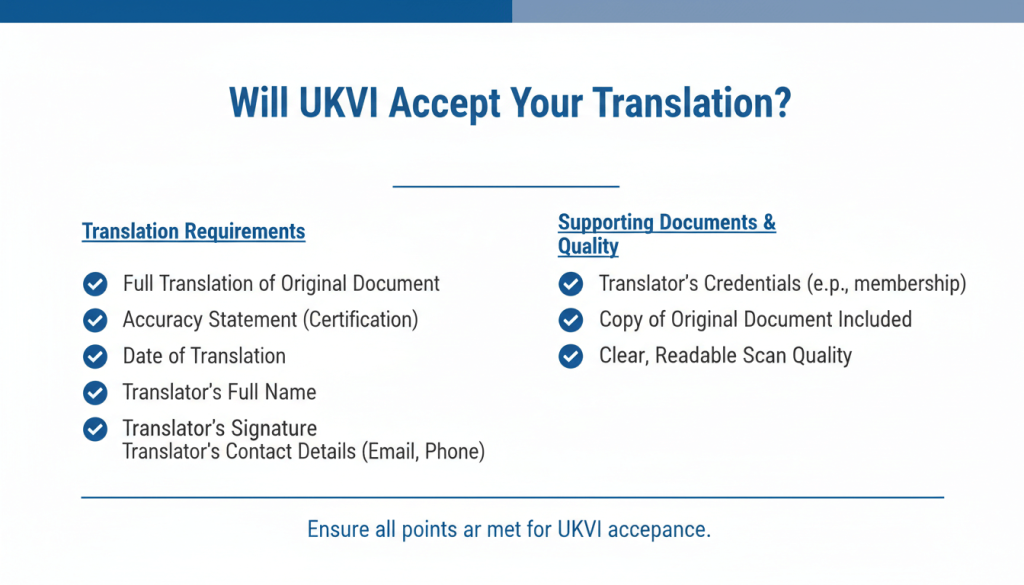
Before you submit, check every translated document against this list:
- Is the original document in a language other than English or Welsh?
- Is the translation complete, not summarised or partially extracted?
- Does the translation reflect names, dates, reference numbers, and amounts exactly?
- Are stamps, seals, handwritten notes, signatures, and marginal notes accounted for?
- Does the certificate clearly confirm that the translation is accurate?
- Is the date of translation shown?
- Is the translator’s full name shown?
- Is the translation signed or formally certified by the company?
- Are phone, email, business address, or other contact details included?
- Can the translator or company be independently verified?
- Have you added credentials where your route may expect them?
- Is the scan readable enough for a caseworker to check quickly?
If you cannot say yes to every line that matters for your route, fix it before you upload.
What the certificate on a UKVI translation should include
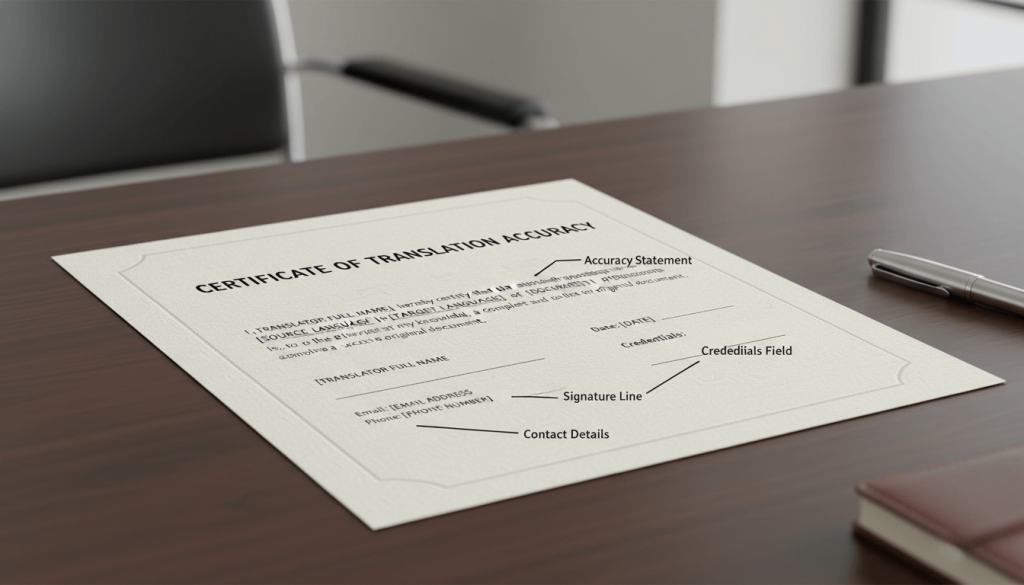
A strong certificate page does not need to be dramatic. It needs to be clear.
A practical format looks like this:
Certificate of Translation Accuracy
I confirm that this document is a true and accurate English translation of the original document.
Document: [name of original document]
Language pair: [source language] to English
Date of translation: [date]
Translator name: [full name]
Signature: [signature]
Company name: [company, if relevant]
Contact details: [email, phone, address, website]
Credentials: [qualification, membership, or professional details, where relevant]
That wording is simple, direct, and easy for a caseworker to understand.
What a weak certificate looks like
A weak certificate usually has one of these problems:
- It says “translated by us” but does not clearly confirm accuracy
- It includes a company logo but no person’s name
- It has a date but no signature
- It has a signature but no contact details
- It looks formal but does not make verification easy
- It covers only one page when the source document has multiple pages or attachments
A polished PDF does not rescue missing essentials.
The point many competing pages miss
Not every UKVI-facing rule is written in exactly the same way across every immigration route. That is where applicants get caught out.
For standard visitor, skilled worker, and student-style evidence, the emphasis is usually on a full certified translation, an accuracy confirmation, the date, the translator’s name and signature, and contact details. For some family-rule evidence and some in-country applications, the wording can go further and expect qualified translator details or credentials as well.
That is why the safest working rule is this:
If there is any chance your case involves spouse, partner, extension, settlement, or in-country permission, include credentials on the certificate as a matter of good practice.
It reduces avoidable questions and makes your file look more submission-ready from the start.
Which documents commonly need certified translation for UKVI
The exact evidence depends on your route, but these are the documents applicants most often need translated.
Family and spouse applications
Common examples include:
- Marriage certificates
- Birth certificates
- Divorce decrees
- Bank statements
- Payslips
- Employment letters
- Tenancy agreements
- Proof of address
- Sponsorship letters
Family-route files are often more document-heavy than people expect. The translation itself may be straightforward, but the supporting pack is where common mistakes appear.
Work visa applications
Common examples include:
- Criminal record certificates
- Degree certificates
- Professional qualifications
- Employer letters
- Financial evidence
- Civil status documents where relevant
Student applications
Common examples include:
- Transcripts
- Diplomas
- Degree certificates
- School certificates
- Consent letters
- Supporting academic documents
Visitor applications
Common examples include:
- Bank statements
- Employment letters
- Invitation letters
- Civil status documents
- Financial support documents
- Accommodation evidence
Full translation means full translation
This is where many applications become risky.
If the original document contains stamps, seals, annotations, side notes, handwritten entries, or multiple pages, those details should not disappear in the English version. A caseworker does not only look at the main typed text. They look at the document as evidence.
That means:
- Do not translate only the front page if the reverse side contains relevant information
- Do not omit stamps and seals
- Do not leave out notes in margins
- Do not replace detailed content with “illegible” unless it is genuinely unreadable
- Do not summarise long financial or civil documents unless the receiving authority has explicitly allowed extracts
For UKVI purposes, “close enough” is not a safe standard.
Common mistakes that delay or weaken applications
These are the most frequent problems seen in UKVI-related translation work.
1. Using a partial translation
Applicants sometimes translate only the section they think matters. That can be a mistake if the rest of the page contains names, official markings, dates, stamps, or references that support authenticity.
2. Missing one certificate detail
A missing date, missing signature, or no contact details can turn a usable translation into a document that invites scrutiny.
3. Assuming any bilingual person can prepare it
Fluency is not the same as a UKVI-ready certified format. The issue is not only language quality. It is independence, presentation, and verifiability.
4. Failing to match the original exactly
A single mismatch in spelling, date format, passport number, account number, or place name can create confusion across the full file.
5. Ignoring supporting marks on the original
Official stamps, seals, embossed markings, and handwritten comments should be accounted for where legible and relevant.
6. Uploading poor scans
A perfect translation cannot compensate for a blurry, cropped, shadowed, or partially cut source document.
7. Confusing certified translation with notarisation or apostille
These are not the same thing. Many applicants overpay for extra services they do not actually need for a UKVI submission.
Do you need notarisation or apostille for UKVI?
Usually, applicants need to focus first on the certified translation itself.
In most UKVI situations, the core question is whether the document is translated properly and whether the translation can be relied on. Notarisation or apostille may matter for other authorities, overseas legal use, or separate document legalisation processes, but they should not be treated as automatic requirements for every UKVI file.
The practical rule is simple:
- Certified translation is the starting requirement for non-English or non-Welsh documents
- Notarisation is an extra service only where specifically asked for
- Apostille/legalisation is a separate document-validation process, not a substitute for translation
What happens if the translation is missing or weak?
Many applicants assume a caseworker will simply “understand the situation” and move on. That is a risky assumption.
If a translated document is missing, incomplete, or difficult to verify, the real problem is not only delay. The bigger problem is that the evidence may carry less weight than the applicant expects. In practical terms, the document stops helping the file.
That is why translation should be handled as part of evidence preparation, not as a last-minute admin task.
A safer submission method for UKVI files
Use this five-step process for every translated document pack.
Step 1: Identify every non-English and non-Welsh page
Do not just look for full documents in another language. Check attachments, annexes, stamps, endorsements, handwritten notes, and reverse pages too.
Step 2: Translate the complete document
Make sure the English version mirrors the content and structure of the source as closely as possible.
Step 3: Attach a proper certificate page
Use clear accuracy wording, include the date, give the translator’s name, signature, and contact details, and add credentials where appropriate.
Step 4: Review consistency across the whole application
Check names, dates, addresses, financial amounts, and reference numbers against the rest of your evidence.
Step 5: Submit both the source and the translation clearly
Make it easy for a caseworker to compare the two without hunting through your upload set.
A quick pass-fail test before you upload
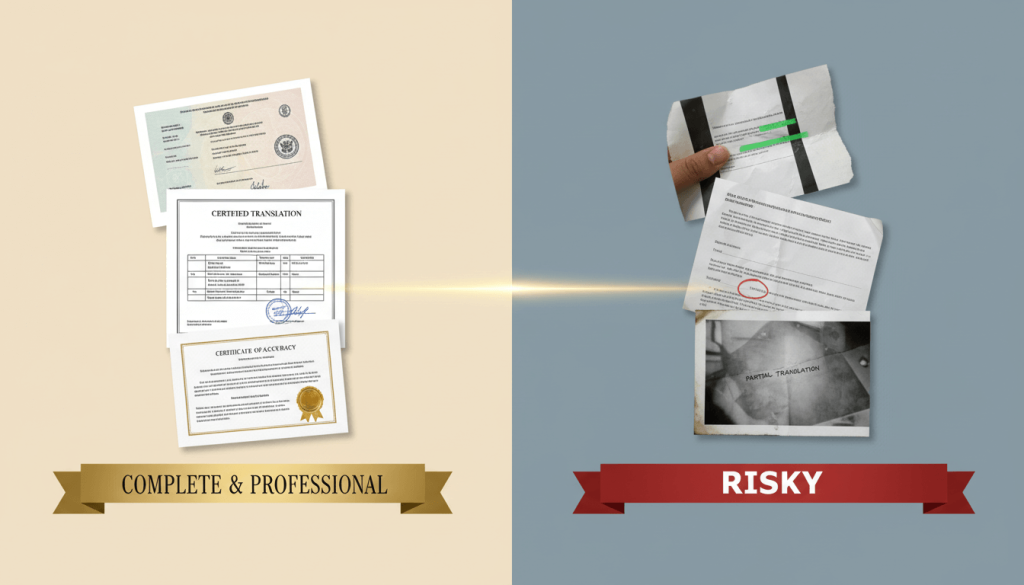
A translation is usually on the right track if:
- It is complete
- It is easy to read
- It includes a clear certificate
- It includes verification details
- It matches the original closely
- It fits the route-specific evidence style
A translation is risky if:
- It is only a summary
- It has no certificate page
- It has no sign-off
- It has no usable contact details
- It omits stamps, notes, or annex pages
- It leaves route-specific credential questions unanswered
Why this matters more for spouse, partner, extension, and settlement files
Family-route applications often involve the most cross-checking.
A spouse or partner application may combine civil documents, financial evidence, housing evidence, employment evidence, and relationship documents in one pack. If only one part is translated weakly, it can affect how smoothly the whole file reads.
For extension or settlement-style applications, it is even more important to avoid minimalist certificate wording. A stronger, more complete certificate helps reduce friction and presents the evidence pack as professionally prepared.
Why applicants use 24 Hour Translation for UKVI files
Applicants usually want the same four things:
- Clear certification wording
- Fast turnaround when deadlines are tight
- Careful handling of official documents
- Confidence that the translation is ready for formal submission
24 Hour Translation is built around those priorities. Documents are prepared for official use, handled securely, and reviewed with practical submission standards in mind.
If your application includes bank statements, civil certificates, employment letters, academic records, or multiple supporting documents, upload your file now and get a quote before the deadline becomes the problem.
Final checklist: will UKVI accept your translation?
Run through this one last time:
- Non-English or non-Welsh document identified
- Full English translation prepared
- Certificate confirms accuracy
- Date included
- Full translator name included
- Signature included
- Contact details included
- Credentials added where helpful or required
- Original scan included
- Stamps, notes, and attachments accounted for
- Everything readable and consistent
If that list is complete, your translation is in a much stronger position to support the application properly.
FAQs
Does UKVI require certified translation for bank statements?
Yes, if the bank statement is in a language other than English or Welsh, it should be accompanied by a certified English translation. Because bank statements are often used as financial evidence, names, dates, balances, and account details must match the original carefully.
Can I translate my own documents for a UKVI application?
It is not a safe approach. UKVI-facing documents should be translated by a professional translator or translation company whose work can be independently verified and properly certified.
Does UKVI need the whole document translated or just the important part?
The safer rule is the whole document. UKVI guidance focuses on full translations, not extracts prepared for convenience. If a page contains stamps, annotations, signatures, or supporting details, those should be reflected too.
Do I need translator credentials on every UKVI translation?
Not always in the same way. Many routes focus on accuracy confirmation, date, signature, and contact details. Some family-rule and in-country situations make credentials more important. Including them where possible is a safer practice.
Does UKVI require notarised translations?
Not as a standard rule for every application. A certified translation is usually the main requirement for non-English or non-Welsh documents. Notarisation is only relevant where a specific authority or process asks for it.
What if only one stamp or one section of the document is in another language?
It still matters. Official marks, handwritten notes, endorsements, and stamps can affect how evidence is understood. Those details should be translated or clearly noted rather than ignored.