When a deadline is tight, most delays do not happen during translation. They happen before the translator can even begin.
A blurry scan. A missing back page. A passport spelling that does not match the certificate. No one knows whether the file is for UKVI, a university, a court, or an employer. The document is “urgent,” but the brief is not ready.
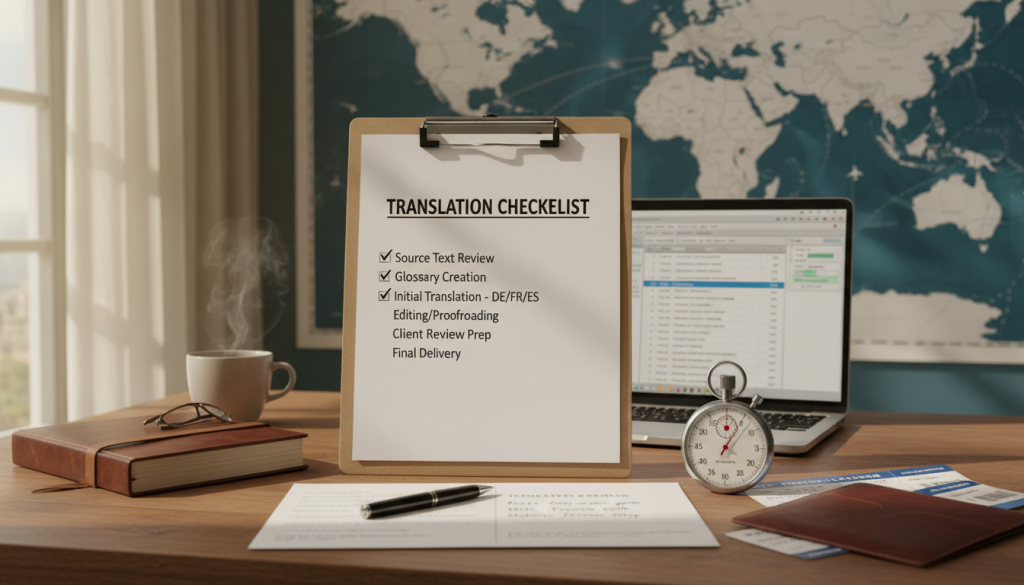
That is exactly why this urgent translation checklist matters.
If you spend 15 minutes preparing the file properly, you can remove the most common reasons urgent jobs slow down, bounce back for questions, or need last-minute corrections. Whether you are sending a birth certificate, marriage certificate, bank statement, academic transcript, contract, or visa pack, the goal is simple: make the document easy to quote, easy to translate, and easy to submit.
If you already have your files ready, start with online certified translation and send the deadline at the same time. That one step alone saves a surprising amount of back-and-forth.
Why urgent translations lose time before work even starts
People often assume speed depends only on how fast the translator works. In practice, urgent jobs move fastest when the file arrives with the right context.
The usual blockers are familiar:
- unclear scans or cropped photos
- missing pages or missing reverse sides
- names spelled differently across documents
- no destination authority stated
- uncertainty about whether certified, sworn, notarised, or legalised format is needed
- multiple documents sent in separate emails
- changes arriving after the work has already started
Fast does not mean rushed. It means fewer preventable questions at the start.
A good urgent translation request gives the translator exactly what they need to begin without guessing.
The 15-minute pre-flight checklist
Minutes 1 to 3: confirm the destination authority and the real deadline
Before you send anything, answer two questions:
- Who is going to read this translation?
- Exactly when does it need to be ready?
“ASAP” is not a deadline. “Today by 4:30 pm UK time for a visa upload” is a deadline.
That difference changes everything. A file for a university admissions portal may need a signed PDF only. A file for an overseas legal process may later need notarisation or legalisation. A file for a solicitor may need a clean digital copy first, with hard copies arranged afterwards.
Write down:
- the authority or organisation receiving the translation
- the submission date and time
- the time zone
- whether digital delivery is enough
- whether hard copies may be needed
- whether the translation is for information, formal submission, or legal use
If you are unsure which route applies, review the certified translation services page before sending the file so the request is framed correctly from the start.
Minutes 4 to 6: send the best possible source file
Urgent work moves faster when the source document is clean. That means:
- full page visible
- all edges and margins visible
- no fingers covering text
- no shadows across stamps or seals
- no blur
- no aggressive compression
- all pages included in the correct order
- both sides included where relevant, especially ID cards and permits
A clear phone photo can be usable. A dark, cropped, angled photo usually is not.
If the document includes stamps, handwritten notes, signatures, side notes, reference numbers, or embossed elements, make sure these can be seen. They often need to be accounted for in the final translation.
For official paperwork, it also helps to send the final version only. If a cleaner PDF exists, use that rather than an older scan. If you are sending multiple documents, combine them into one pack where possible.
You can also review the types of official documents we translate to make sure nothing obvious has been left out of the bundle.
Minutes 7 to 9: lock the correct names, dates, and reference details
This is the most overlooked part of an urgent translation checklist. Do not assume the translator knows which spelling should control if the source document and passport spell a name differently. In official submissions, consistency matters.
Before sending, confirm:
- passport spelling of all names
- date of birth
- document numbers
- case or application reference numbers
- employer, university, or company names
- preferred spelling for places where multiple transliterations exist
A simple note like this can prevent corrections later:
“Please use the passport spelling: Mohamed Al Hashimi. The birth certificate shows Mohammad Al-Hashemi, but the passport version is the spelling used in the application.”
That one line can save a full revision cycle.
Minutes 10 to 12: give the translator context, not just files
A document without context creates avoidable questions. Your email should explain:
- what the document is
- what it is for
- where it will be submitted
- whether it is part of a larger pack
- whether previous translations exist
- whether terminology must stay consistent across several documents
This matters even more for legal, academic, and immigration files. A bank statement sent for a visa application is treated differently from a bank statement sent for internal HR review. An academic transcript for Ecctis is not the same as a transcript for a private employer.
If you are sending a pack of related documents, say so. Terminology consistency across a bundle is often just as important as speed.
If your document uses a less common language pair, it helps to check the languages we cover and mention the source and target language clearly in your first message.
Minutes 13 to 15: remove the avoidable blockers
Now do one final sweep before you send. Ask yourself:
- Is this the final version of the source document?
- Have I included every page?
- Have I stated the exact deadline?
- Have I named the receiving authority?
- Have I explained whether I need digital delivery only?
- Have I flagged any name spelling issues?
- Am I available to answer follow-up questions quickly?
Urgent jobs slow down when the translator sends one clarification email and then waits. If the job is genuinely time-sensitive, stay reachable after submission. A five-minute approval gap at the start can become a missed slot later in the day.
Copy-and-send urgent translation checklist
Use this as your email template when time is short:
Subject: Urgent translation request – [document type] – [deadline]
Message:
Hello,
Please quote for an urgent translation of the attached document(s).
Document type: [birth certificate / transcript / contract / bank statement / other]
Source language: [language]
Target language: [language]
Destination authority: [UKVI / university / solicitor / employer / court / embassy]
Deadline: [date, time, time zone]
Delivery needed: [signed PDF only / hard copy may also be needed]
Certification needed: [certified / not sure / advised by authority]
Name spelling to follow: [passport spelling]
Notes: [multiple pages / multiple documents / previous translation exists / keep terminology consistent]
Thank you.
This format removes the guesswork and helps an urgent job start faster.
What to check by document type
Personal documents
For birth certificates, marriage certificates, divorce decrees, passports, and ID cards, check:
- full page visible
- stamps and seals readable
- both sides included where relevant
- passport spelling provided if names differ across records
- all linked civil documents included if they support the same application
A marriage certificate may be straightforward on its own, but if it is being used to explain a surname change, the passport or name change evidence may matter too.
Immigration and visa documents
For visa packs, the biggest issue is incomplete bundles. Check:
- every supporting page is present
- bank statements include the relevant dates
- employment letters are complete
- sponsor letters are signed where required
- any non-English supporting evidence is included in the same batch
- the destination authority is named clearly
If the submission is for a fast-moving immigration timeline, bundling everything at once usually helps more than sending separate urgent jobs one after another.
Academic records
For diplomas, transcripts, and supporting letters, check:
- all pages are included
- stamps, dates, and grading notes are readable
- names match the current identity document
- if the current name differs, supporting name-change evidence is available
- the institution name is clear and consistent across the pack
Academic packs often move faster when the transcript and certificate are handled together rather than separately.
Legal and business documents
For contracts, powers of attorney, court orders, shareholder documents, and financial records, check:
- the final signed version is being sent
- page order is correct
- annexes, schedules, exhibits, and side notes are included
- signatures, seals, initials, and handwritten amendments are visible
- reference numbers and defined terms are clear
- the receiving authority or legal purpose is stated upfront
Urgent legal translation is usually less about typing speed and more about reducing risk. A missing appendix can be more damaging than a short delay.
What a submission-ready urgent translation should include
A fast translation is only useful if it is ready to use. For most official purposes, the finished pack should be clear, complete, and professionally prepared. Depending on the route, that often means:
- full translation of the relevant content
- correct handling of stamps, seals, signatures, and annotations
- a certification statement where required
- the date of certification
- translator or company sign-off details
- a clean digital file that is easy to forward or upload
- hard copy options where the receiving authority needs them
This is why many clients choose online certified translation when time is tight. It keeps the process simple: upload, confirm, translate, review, and deliver.
The mistakes that turn urgent into delayed
Sending screenshots instead of full documents
A screenshot is rarely enough for official work. It can cut off margins, reference numbers, stamps, and footer details.
Forgetting the back of an ID card
This happens constantly. If the reverse side contains an address, issue date, machine-readable text, or official wording, it may need to be translated too.
Not stating the destination authority
A translation for a visa pack, a university, and a foreign notary are not all prepared the same way.
Sending updates after the job starts
Every new page, correction, or replacement file creates rework. For urgent requests, freeze the source file before sending where possible.
Ignoring spelling differences across documents
If the passport says one thing and the certificate says another, flag it immediately. Silence creates avoidable correction requests.
Waiting too long to ask whether hard copies are needed
If physical delivery matters, that should be raised at the beginning, not after the PDF has been delivered.
Three fast-moving scenarios
Scenario 1: the one-page certificate
A client needs a marriage certificate translated for a same-day upload. The scan is clear, the full page is visible, the passport spelling is supplied, and the destination authority is identified in the first email. This is the kind of urgent job that usually moves cleanly because nothing is missing.
Scenario 2: the transcript pack
A student sends the diploma first, then the transcript later, then a new passport name note after the quote. The job is still possible, but the timeline becomes harder to control because the pack keeps changing.
Scenario 3: the legal file with annexes
A contract is marked urgent, but two annexes and the signed page were omitted from the original email. The translation cannot be treated as complete until the missing sections arrive. The initial rush label does not fix an incomplete brief.
The lesson is simple: complete beats frantic.
Why this checklist works
The best urgent translation checklist does not try to make complex work magically instant. It removes the preventable friction that slows good work down.
It helps you:
- reduce clarifications
- avoid missing pages
- protect name consistency
- choose the correct certification route earlier
- make quoting faster
- make formatting smoother
- improve the chances of first-time acceptance
If the file is ready and the brief is clear, the translator can focus on the work instead of detective tasks.
Ready to move fast without creating new problems?
If your deadline is close, send the document as one clean pack, state the authority, state the exact deadline, and flag any spelling issues in the first message.
For urgent official submissions, start with 24 Hour Translation’s online certified translation service. If you are sending multiple documents or you are unsure about the correct route, contact the team directly with the file and the deadline in the same message.
A fast translation starts with a complete brief.
FAQs
What is an urgent translation checklist?
An urgent translation checklist is a short pre-send process that helps you prepare the file properly before requesting a rush service. It typically covers clear scans, full pages, correct names, destination authority, certification needs, and the exact deadline.
Can I use photos instead of scans for an urgent translation?
Yes, but only if the photos are clear, flat, complete, and readable. For an urgent translation checklist, the key test is whether the whole page is visible, including margins, stamps, signatures, and side notes. If a cleaner PDF or scan exists, use that first.
Why does the destination authority matter in an urgent translation checklist?
The destination authority affects how the translation should be prepared. A document for a visa application, court filing, university submission, or employer check may require a different format, certification route, or delivery method. Naming the authority early reduces delays.
What should I do if the name on my document does not match my passport exactly?
State the passport spelling clearly in your first message and explain the difference. This is one of the most important parts of an urgent translation checklist because name mismatches often create last-minute correction requests.
Can a certified translation be delivered digitally for urgent deadlines?
In many cases, yes. A signed PDF is often the fastest and most practical option for urgent official submissions. If the receiving authority may later need a physical copy, mention that at the start so the delivery route can be planned properly.
What is the fastest way to start an urgent certified translation?
Send one complete email with the final files, source and target language, exact deadline, destination authority, certification requirement if known, and the correct passport spelling of names. That gives the translator enough information to quote and begin without avoidable back-and-forth.