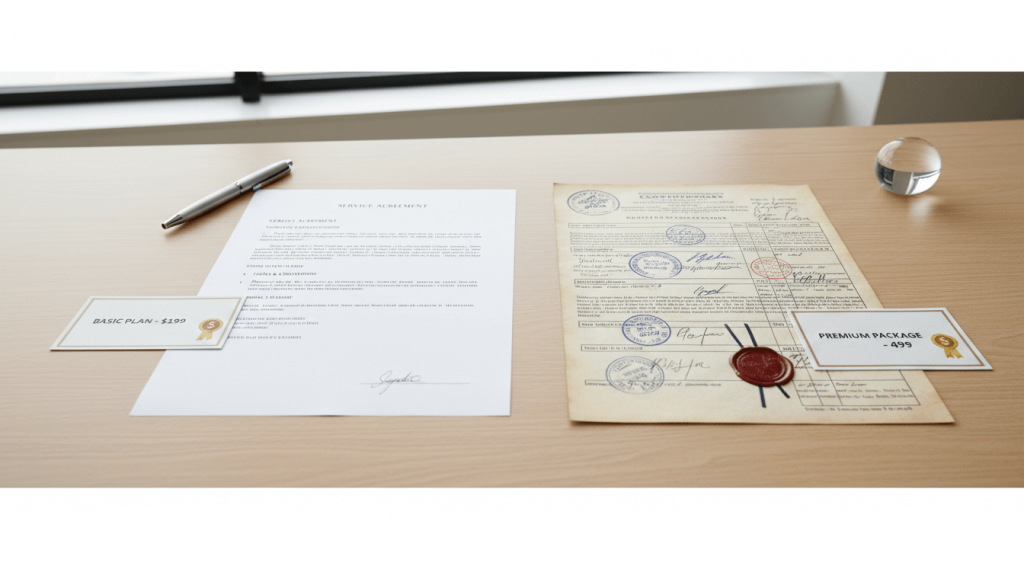
Translation pricing UK explained in plain English: two documents that look almost identical on screen can create very different amounts of work behind the scenes. One may be a clean, typed certificate that moves quickly from translation to checking to certification. The other may have stamps, handwritten notes, poor scan quality, awkward formatting, and a same-day deadline. To a client, they both look like “two pages”. To a professional team, they are not the same job at all.
That is why the fairest translation quote is not based on appearances alone. It is based on the real workload, the level of risk, the formatting involved, and the time pressure attached to the job.
If you have ever wondered why one provider prices by page, another by word, and a third gives you a higher quote for a document that seems similar to the last one, this guide will make the logic clear.
The short answer
A translation quote is usually shaped by four things:
- How much text actually needs translating
- How difficult that text is to translate accurately
- How much formatting or document reconstruction is required
- How quickly the work has to be delivered
That is the real reason two similar documents can cost different amounts.
A translation quote is rarely about how many pages you can see. It is about how much language work, checking, formatting, and deadline pressure sits behind those pages.
A better way to understand pricing: text, risk, layout and time
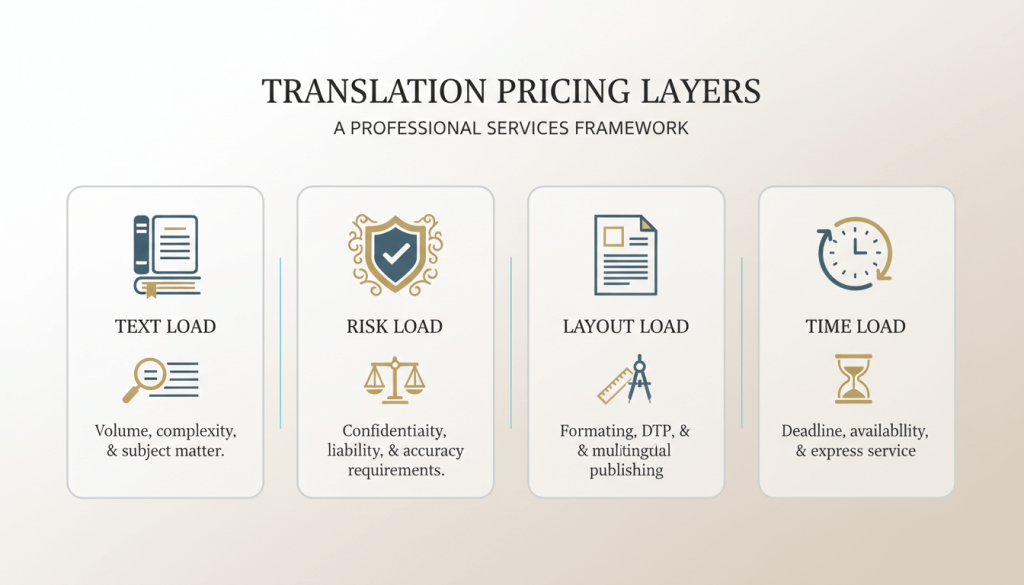
Most pricing pages stop at “it depends on the document”. That is true, but it is not very helpful. A clearer way to understand the price is to look at four layers.
1. Text load
This is the most obvious factor, but it is still widely misunderstood.
A one-page certificate might contain 120 words. A one-page bank statement might contain 450 words once you count headings, transaction descriptions, notes, and footer text. A two-page licence scan can sometimes contain less text than a single-page academic transcript full of modules, dates, grades, and institutional remarks.
This is why cost per page vs per word is such a common source of confusion. Page count is visible. Word count is not.
2. Risk load
Some documents carry more risk if anything is missed, mistranslated, or formatted badly.
Examples include:
- court documents
- contracts
- immigration evidence
- academic records
- financial statements
- company registration papers
A short document with legal consequences may require more careful terminology checks than a longer routine document. That extra care is part of the value of the service.
3. Layout load
Not every document is just text in paragraphs.
A translation may involve:
- tables
- stamps and seals
- side notes
- handwritten amendments
- signatures that need marking clearly
- headers and footers
- difficult scan quality
- duplicated fields across forms
- visual structure that should be mirrored in the final file
This is where formatting costs often enter the picture. The translation itself may be straightforward, but rebuilding the document so it is readable, professional, and suitable for submission can take significant time.
4. Time load
Urgency changes pricing because it changes workflow.
A normal deadline allows proper scheduling, review, and delivery without disrupting other projects. An urgent deadline may require priority handling, reassigning staff, evening work, or compressing production and quality checks into a much tighter window.
That is where rush surcharges come from. You are not only paying for speed. You are paying for priority.
Cost per page vs per word: which model is fairer?
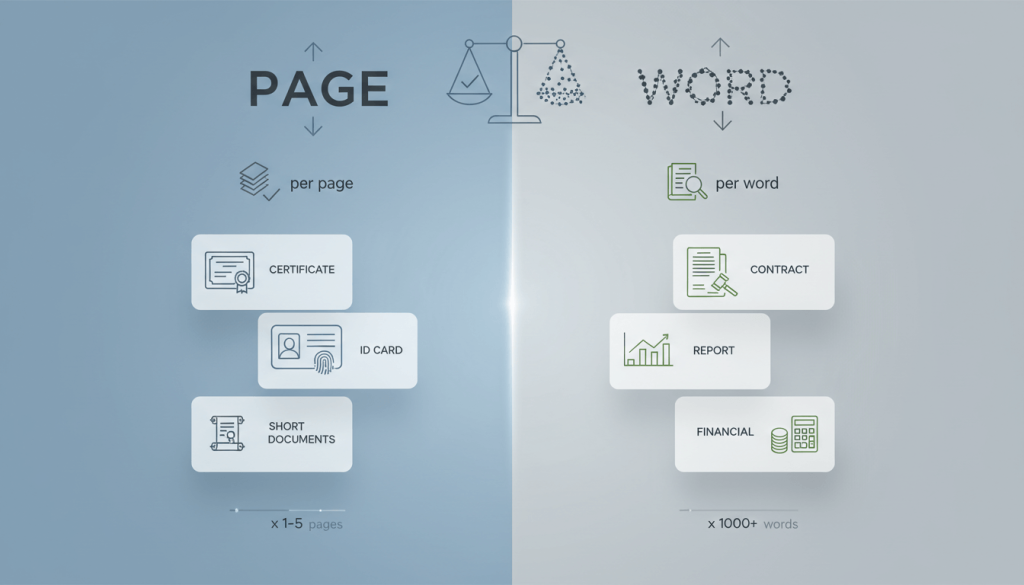
Both models can be fair. The right one depends on the document.
When per-page pricing makes sense
Per-page pricing often works well for short, standardised official documents such as:
- birth certificates
- marriage certificates
- driving licences
- passports
- police certificates
- simple diplomas
These documents are usually predictable in structure. The provider knows roughly how much text and layout work a standard page is likely to involve, so a page-based quote can be fast and practical.
When per-word pricing is more accurate
Per-word pricing is often more accurate for documents where text density varies widely, such as:
- contracts
- witness statements
- financial reports
- terms and conditions
- academic transcripts
- company accounts
- medical reports
In these cases, two documents with the same page count can contain very different amounts of translatable content. Pricing by word avoids underpricing dense files and overpricing sparse ones.
Why very short jobs still have a minimum charge
Clients are sometimes surprised that a very short file still carries a minimum charge.
That is usually because the service does not begin and end with typing translated words. Even a short official document may still require:
- file review
- quote preparation
- translator allocation
- quality check
- certificate preparation
- final formatting
- delivery handling
A small document can be short on words but still require a complete professional process.
The charges people miss when comparing quotes
A low headline number can be misleading if it excludes parts of the job that matter to your submission.
Certification fees
A certified translation is not just translated text with a quick signature added at the end. For many official uses, the provider is preparing a submission-ready document pack. That often includes the translation, an accuracy statement or certificate, final review, and delivery in the correct format.
So when you compare quotes, check whether certification is included or added separately.
Formatting costs
Formatting is one of the biggest reasons a quote changes after file review.
Examples that can increase layout time include:
- multiple stamps and seals
- tables with tight spacing
- poor-quality scans
- handwritten notes
- complex academic records
- financial statements with columns and footnotes
- forms that need visual alignment
A provider may translate the text at one rate and then add formatting or DTP time where the file demands it.
Rush surcharges
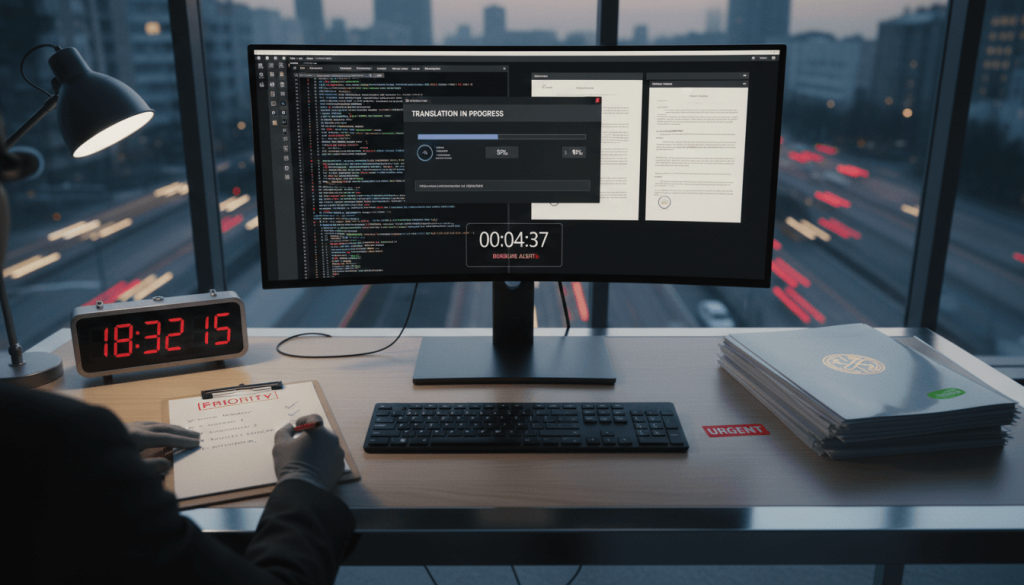
Urgency affects more than the calendar. It affects resource planning.
A same-day translation may require:
- immediate file review
- priority assignment
- condensed QA
- out-of-hours handling
- faster response cycles for client queries
If two documents are identical but one is needed tomorrow and the other is needed in two hours, they should not cost the same.
Hard-copy and delivery extras
Some projects only need digital delivery. Others need printed copies, wet signatures, postage, or courier delivery. These are not always included in the base price, so they should be checked before you compare providers.
Three examples that explain why “similar” documents price differently
Example 1: Two one-page certificates
Document A: a clean, typed birth certificate with clear print and simple layout.
Document B: a birth certificate from the same country, but with stamps, handwritten marginal notes, faint scan quality, and an amendment box.
To the client, both are one page.
To the translator, the second file takes longer to read, confirm, lay out, and check.
This is one of the clearest examples of translation pricing UK explained properly: similarity in page count does not mean similarity in workload.
Example 2: Two six-page financial packs
Document A: a selectable PDF with clear text, consistent tables, and sharp scan quality.
Document B: six scanned pages with tiny numbers, column-heavy layouts, footnotes, signatures, and uneven alignment.
Both are six pages. One is much easier to process. The second may involve more careful number handling, layout recreation, and quality checking.
When clients say, “But the document looks the same length,” this is often the hidden difference.
Example 3: Same word count, different deadline
Document A: 900 words, needed in three working days.
Document B: 900 words, needed today before close of business.
The text load is identical. The time load is not.
The urgent file may need priority routing and concentrated review. That is why rush surcharges are often perfectly reasonable rather than arbitrary.
Why official-use documents often cost more than general translations
General content can sometimes be priced more simply. Official documents usually cannot.
When a document is intended for a visa application, court matter, university, employer, or corporate filing, the margin for error is smaller. Names, dates, reference numbers, stamps, and formatting cues matter more. Even where the wording is simple, the checking standard must be higher.
That is also why certification fees should be viewed as part of the service package, not as a cosmetic extra.
How to compare quotes properly
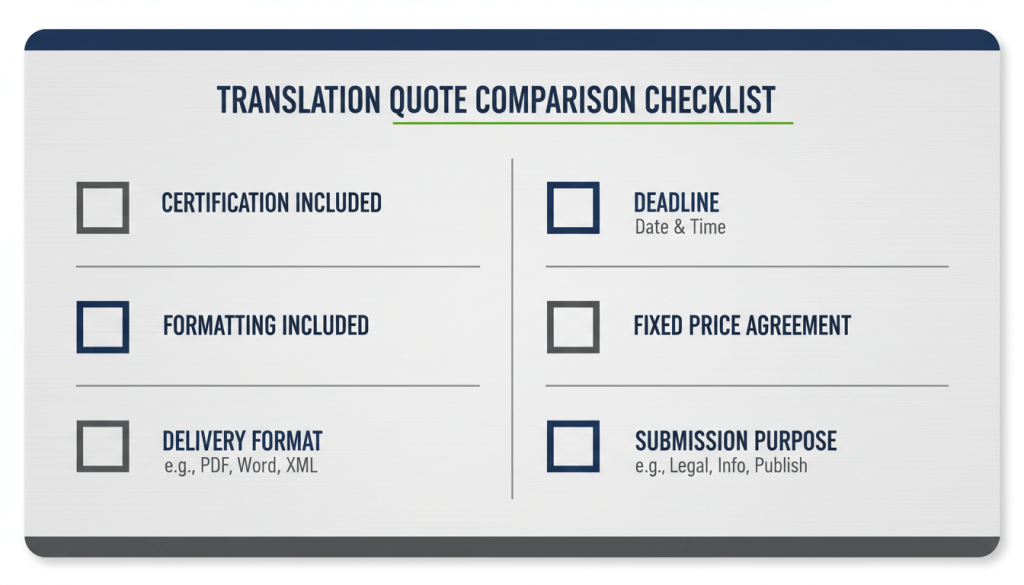
When you request quotes from different providers, do not compare the total only. Compare what sits behind the total.
Ask these questions:
- Is the price based on page count, word count, or a minimum job fee?
- Is certification included?
- Are formatting costs included?
- Is digital delivery included?
- Are hard copies, postage, or courier charges extra?
- Is the quote fixed after file review, or only an estimate?
- Does the provider know where the document will be submitted?
- What turnaround is included, and what counts as urgent?
A slightly higher quote can be better value if it includes the pieces that another provider adds later.
How to keep your translation cost down without cutting corners
There are sensible ways to reduce cost without lowering quality.
Send the clearest scan you can
Poor image quality slows everything down. A sharp, flat, readable scan is easier to price and easier to translate.
Send the full document at once
If you know you will need several pages or related files translated, send them together. That helps avoid repeated minimum charges and reduces admin friction.
Explain the purpose of the translation
Tell the provider whether the file is for a visa, university, court, employer, or company submission. That helps them quote the correct service the first time.
Avoid last-minute deadlines where possible
Urgency is one of the fastest ways to increase price. If you can plan ahead, you usually get more flexibility and a lower quote.
Ask what is included
A cheap-looking quote can become expensive once certification, formatting, and delivery are added later.
What a good translation quote should feel like
A strong quote should feel clear, not vague.
You should be able to understand:
- what is being translated
- what level of service you are receiving
- whether certification is included
- what format you will receive
- when it will be delivered
- whether any extras apply
If a quote leaves you guessing, it is harder to trust.
The real takeaway
The fairest way to price a translation is to review the actual file rather than guess from the page count alone.
That is especially true for official documents. A translation is not only about replacing words in one language with words in another. It is about producing a document that is accurate, readable, properly checked, correctly presented, and delivered in time for the purpose you need.
So if two similar documents receive different quotes, that is not necessarily inconsistency. Very often, it is a sign that the provider has looked closely enough to spot the real differences.
Need an exact price, not a rough estimate?
If you need a firm number rather than a broad range, the fastest route is to send the actual file, confirm the language pair, and say when and where the translation will be used. That allows the quote to reflect the real workload, the right certification level, and the deadline that matters to you.
For urgent official documents, a clear file and a precise brief usually lead to a faster, more reliable quote than any online guesswork ever can.
FAQs
What does translation pricing UK explained actually mean?
It means looking beyond page count. In the UK, translation prices often depend on the amount of text, the complexity of the document, the certification required, the formatting involved, and the deadline.
Is cost per page vs per word better for certified translations?
Neither model is always better. Per-page pricing often suits short standard documents such as certificates, while per-word pricing is usually fairer for dense files like contracts, reports, and financial statements.
Why do rush surcharges apply to translation jobs?
Rush surcharges apply because urgent work requires priority handling. The provider may need to rearrange schedules, assign staff immediately, and compress review and delivery into a shorter timeframe.
Do formatting costs really affect translation prices?
Yes. Documents with tables, stamps, handwritten notes, or difficult layouts often take longer to prepare and check. That extra production time can affect the final quote.
Are certification fees separate from translation fees?
Sometimes. Some providers bundle certification into the total price, while others add it as a separate charge. Always check whether the certificate, final review, and delivery format are included.
Can two certificates from the same country cost different amounts?
Yes. One may be a clean standard layout, while another may include handwritten amendments, poor scan quality, seals, or extra notes. Those details can change the time needed to translate, format, and certify the file.