
If someone in the UK tells you to get a sworn translation, do not assume that “sworn” is automatically the right format. In the UK, authorities normally ask for certified translations, while sworn translations usually belong to legal systems where translators are formally appointed by a court or state authority. In practice, the real issue is not the document itself. It is who will receive it, in which country, and what wording that authority uses. (iti.org.uk)
The document does not decide the format.
The receiving authority does.
That single rule saves people time, money, and rejected submissions.
If you are working to a deadline, send the document, the destination country, and the authority name before ordering. A quick check at the start can tell you whether you need a certified translation, a sworn translation, notarisation, apostille, or a combination of those.
What “sworn translation” means in plain English
A sworn translation is a translation produced in a legal format by a translator who has official authority in a specific jurisdiction. That translator may be court-appointed, government-authorised, or entered on an official register, depending on the country. The translation usually carries a signature, declaration, stamp, seal, or other formal marker that gives it legal standing for that system. (European e-Justice Portal)
In plain English, a sworn translation is not simply a more careful translation. It is a translation with a recognised legal status in the destination country.
That is why the phrase creates confusion in Britain. Clients hear “sworn” from an overseas registry, embassy, lawyer, or family member abroad and assume there must be a British version of the same thing. Usually, there is not. The UK does not operate a general sworn translator system in the same way many civil-law countries do. (iti.org.uk)
Why people in the UK get asked for sworn translations
Most confusion starts with one of these situations:
- you are submitting a UK document to an overseas civil registry
- you are registering a marriage, birth, divorce, or name change abroad
- you are filing paperwork with a foreign court, notary, municipality, ministry, or consulate
- you are dealing with overseas inheritance, probate, property, or immigration paperwork
- an authority abroad has used a local term that really means “official translation by an authorised translator”
Common examples include requests for a court-approved translation, an official translation, or a translation by a locally recognised sworn translator. The wording varies by country, but the pattern is the same: the receiving body wants a format that fits its own legal system.
When certified translation is usually enough in the UK
For UK authorities, the usual requirement is not “sworn.” It is certified.
That applies across many immigration and official-document contexts. Current UK guidance says that where documents are not in English or Welsh, applicants must provide a fully certified translation from a professional translator or translation company that can be independently verified. The translation should include confirmation of accuracy, the date, the translator’s full name and signature, and contact details. Appendix FM-SE also adds credential-related detail for certain applications. (GOV.UK)
What a UK-ready certified translation should include

A strong certified translation for UK use should normally contain:
- a statement confirming it is a true and accurate translation
- the date of translation
- the translator’s full name
- a signature from the translator or authorised company representative
- contact details for verification
- a clear link to the original document
- clean formatting that shows the document is a translation, not an original
For many UK submissions, that is the format that matters most. Not “sworn.” Not “notarised.” Not “apostilled.” Just properly certified and professionally prepared.
Sworn, certified, notarised, apostilled: what is the difference?
These terms are often mixed together, but they solve different problems.
Certified translation
A professional translation with a signed certificate of accuracy for official use. In the UK, this is the format most commonly requested by authorities and institutions. (GOV.UK)
Sworn translation
A translation issued by a translator who has formal legal authority in a particular country or jurisdiction. It is usually for use where that specific legal status is recognised. (European e-Justice Portal)
Notarised translation
A translation where the translator’s signature, declaration, or affidavit is witnessed by a notary. The notary is not certifying the linguistic quality of the translation itself; the notary is confirming the signature or formal act.
Apostilled or legalised translation
A document package that has gone through legalisation so it can be accepted abroad. In the UK, the Legalisation Office attaches an apostille to confirm the authenticity of a signature, seal, or stamp on eligible UK documents. This is often relevant when another country specifically asks for legalisation. (GOV.UK)
The same document can need four different formats
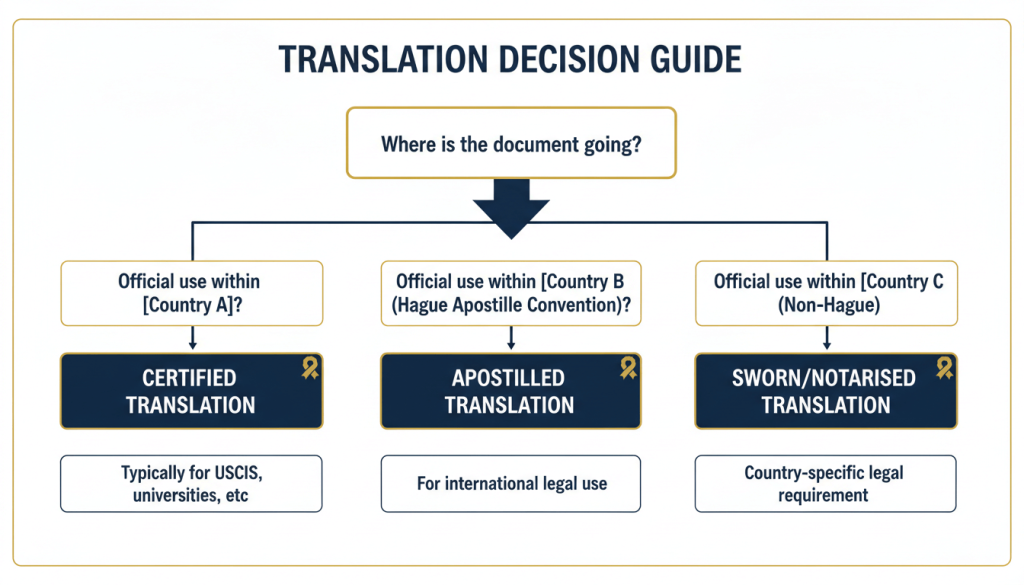
A birth certificate is a useful example.
The same certificate might be:
- certified for a UK visa application
- sworn for a foreign civil registry that uses authorised translators
- notarised where a receiving body wants a notarial layer
- apostilled where the foreign authority asks for legalisation as well
So when people ask, “Does a birth certificate need a sworn translation?” the honest answer is: sometimes, but only if the receiving authority says so.
The same logic applies to marriage certificates, divorce decrees, police certificates, powers of attorney, degree certificates, company records, and court papers.
Who actually asks for sworn translations?

The bodies most likely to ask for sworn translations are usually outside the UK.
Overseas civil registries and municipalities
These are common in marriage registration, birth registration, family-status changes, and nationality or residency applications.
Foreign courts and judicial bodies
Where a country uses officially appointed legal translators, a standard certified translation from the UK may not be enough on its own.
Ministries, consulates, and notaries abroad
These bodies may use local wording that points to a sworn format, notarisation, or legalisation.
Some universities, licensing bodies, and recognition offices
Not all do, but some follow national formalities closely and want an official format tied to their own jurisdiction.
The practical lesson is simple: if the document is staying in the UK, certified is often enough. If it is going abroad, especially into a registry, court, or ministry, the chance of a sworn or further-authenticated format goes up.
The four checks to do before you order anything

Before paying for translation, confirm these four points:
- Which country will receive the document?
Sworn status is jurisdiction-specific. What works for one country may not work for another. - Which authority is receiving it?
A university, court, embassy, registry office, and private employer may each ask for different formats. - What exact wording have they used?
Look for terms such as certified, sworn, official, notarised, legalised, apostilled, court-approved, or authorised translator. - Do they want scans, hard copies, originals, or a sealed pack?
Some bodies accept digital submissions. Others want physically signed, stamped, or bound documents.
This is where many rejected applications begin: not with poor translation, but with ordering the wrong format.
The biggest mistakes people make
The most common problems are surprisingly predictable.
Ordering a UK-certified translation for a foreign sworn-translation requirement
A strong certified translation can still be the wrong format if the foreign authority wants a translator authorised in its own system.
Assuming “sworn” means “better”
It does not. Sworn refers to legal status, not superior wording.
Paying for notarisation when notarisation was never required
Notarisation adds cost and time. It should only be added when the authority actually wants it.
Confusing apostille with translation
Apostille is a legalisation step. It does not replace translation, and translation does not replace apostille. (GOV.UK)
Failing to provide the authority’s wording
If your translator never sees the exact request, they are forced to guess. Guessing is expensive.
What to send your translation provider
To get the right format first time, send:
- a clear scan or photo of the document
- the destination country
- the name of the receiving authority
- the exact wording from the checklist, email, or portal
- your deadline
- any note about hard copies, stamps, or legalisation
That extra context often matters more than the document itself.
What to do if the authority simply wrote “sworn translation”
Sometimes the request is vague. That does not mean you should panic.
Start by asking:
- Do you require a certified translation, a sworn translation, or both?
- Must the translator be registered or court-appointed in your country?
- Do you require notarisation?
- Do you require apostille or legalisation?
- Do you accept digital copies, or do you need original hard copies?
If they do not answer clearly, the safest route is to work backwards from the country and the authority rather than from the document name alone.
A practical way to think about it
Here is the simplest framework:
- Inside the UK: usually certified
- Abroad, private use: often certified, sometimes notarised
- Abroad, official registry or court use: often sworn or similarly official in that jurisdiction
- Abroad, formal legal recognition: may need sworn plus notarisation and/or apostille
That is why a plain “sworn translation UK meaning” search can be misleading. People are usually not trying to define a word. They are trying to avoid sending the wrong type of document to the wrong authority.
Why this matters for speed as well as acceptance
The fastest translation is not always the cheapest one. The cheapest one is not always the acceptable one.
A rejected submission can mean:
- new translation fees
- new notary fees
- courier costs
- missed appointments
- delayed visa, marriage, property, or court timelines
A quick format check at the beginning is usually the most efficient step in the whole process.
If you want clarity before you commit, send us the file, the destination country, and the receiving authority. We will tell you whether you are looking at certified, sworn, notarised, apostilled, or a combination—before work starts.
Final word
In the UK, “sworn translation” is usually not the standard format for UK authorities. It is more often an overseas requirement linked to a country that recognises court-appointed or state-authorised translators. So the right question is not, “Do I need sworn translation because my document is official?” The right question is, “What exact format does the receiving authority require?”
Get that answer right, and everything else becomes much easier.
Need the correct format without the back-and-forth? Upload your file, tell us where it is going, and we will help you prepare a submission-ready translation that fits the authority asking for it.
FAQs
What is the sworn translation UK meaning?
In UK searches, the phrase usually refers to an official translation format recognised in other countries, not a standard British translation category. UK authorities more commonly ask for certified translations, while sworn translations are tied to jurisdictions that formally authorise translators. (iti.org.uk)
Is a sworn translation required in the UK?
Usually no. In the UK, official bodies generally ask for certified translations that can be independently verified, rather than sworn translations. (GOV.UK)
What is the difference between sworn and certified translation?
A certified translation is a professional translation with a signed statement of accuracy. A sworn translation depends on the translator having formal legal authority in a specific country or jurisdiction. (European e-Justice Portal)
Who asks for sworn translations?
Sworn translations are most often requested by overseas civil registries, courts, ministries, consulates, and other public authorities in countries that recognise officially appointed translators. (European e-Justice Portal)
Do I need notarisation or apostille as well?
Sometimes. Notarisation and apostille are extra formalities that may be required for international use, especially when a foreign authority specifically asks for them. They are separate from the translation itself. (GOV.UK)
Can the same document need certified in one place and sworn in another?
Yes. The same birth certificate, marriage certificate, or court document may be certified for one authority and sworn or legalised for another, depending on the receiving country and institution. (iti.org.uk)