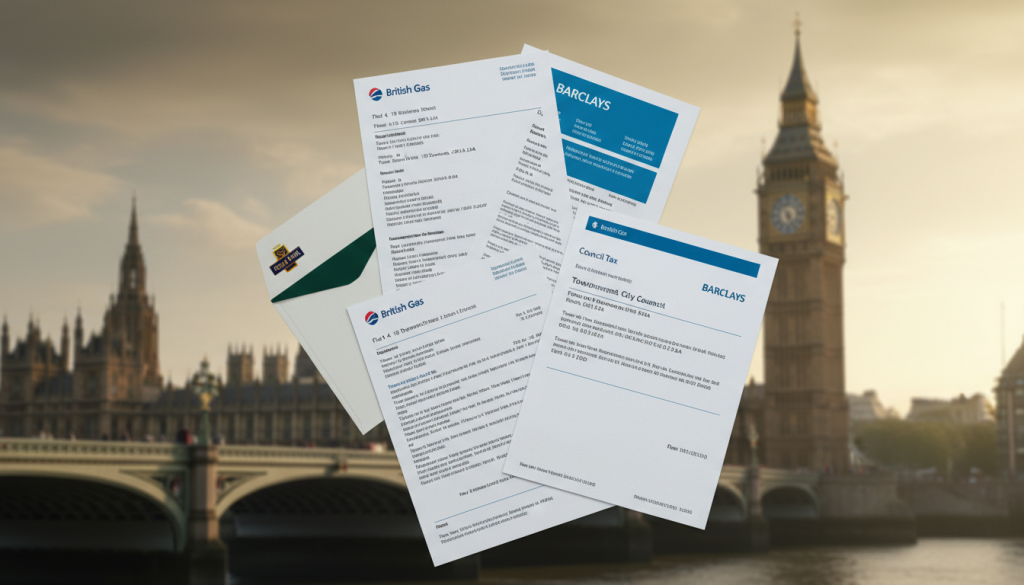
What usually counts as proof of address in the UK
The phrase “proof of address” covers more than one document type, and different bodies apply different date windows. Common examples include:
- gas, water or electricity bills
- bank or building society statements
- council tax bills
- mortgage statements
- tenancy agreements
- employer letters
- letters from a local council or government department
- bank account opening confirmation letters
Government and bank guidance shows that date rules vary. A utility bill is often expected to be recent, commonly within the last 3 to 4 months. Bank statements may be accepted from the last month, last 3 months, or last 4 months depending on the institution. Council tax bills are commonly accepted if they are from the current financial year or issued within the last 12 months. Some processes also accept official letters from councils or government bodies, while certain identity checks still insist on original or paper copies.
That gives rise to one of the most useful practical rules on this subject: the strongest proof-of-address document is not always the easiest one to find. It is the one the receiving body has actually asked for, in the date range they will accept. A current council tax bill can be stronger than a single monthly utility bill. An annual bank statement can be stronger than one isolated page from a mobile banking app. An official bank letter confirming account opening and address can be more persuasive than generic bank mail. The point is not to translate the fastest document. It is to translate the document most likely to be accepted.
Utility bill translation, council tax translation, and bank mail are not interchangeable
People often assume that any document showing an address will do. In practice, institutions look at three things:
- Issuer credibility: A local council, regulated bank, utility provider, HMRC, employer, university, or healthcare provider usually carries more weight than informal correspondence.
- Freshness: Date windows are often strict. Some bodies want the last month. Others allow 3 months, 4 months, or the current financial year.
- Coverage: A document that covers a longer period can be more useful where residence history matters. GOV.UK guidance for EU Settlement evidence explicitly notes that annual bank statements and council tax bills can cover longer periods, while a single monthly electricity bill or official letter may only count for one month.
So if your receiving body wants simple current address evidence, a recent utility bill or statement may be enough. If they want residence over time, a council tax bill, annual bank statement, or longer-span official record may be the better choice.
What a certified proof of address translation should include
For official UK use, the translation itself matters as much as the source document. Home Office-facing guidance is consistent: where a document is not in English or Welsh, the translation should be full, certified, and independently verifiable. That means the translated file should include:
- confirmation that it is an accurate translation of the original document
- the date of translation
- the translator’s full name
- the translator’s signature, or the signature of an authorised official from the translation company
- the translator’s or translation company’s contact details
This is also where people confuse two different things: a certified translation confirms the translation is true and accurate, while a certified copy confirms a copy matches the original document. Those are not the same service. A solicitor-certified photocopy of a bank statement is not a substitute for a certified translation of a non-English bank statement, and a certified translation does not automatically replace any separate requirement for a certified copy.
What should be translated on proof-of-address documents
One of the biggest reasons proof of address translations get questioned is partial translation. If the receiving body expects a full translation, only translating the name and address section is risky.
A proper proof of address translation should usually include:
- document title
- issuer name
- account holder name
- full address lines
- issue date
- billing or statement period
- account or reference number
- balances or key billing figures where shown
- notes, sidebars, footers, and headers
- stamps, seals, annotations, and handwritten notes where present
For proof of address documents, that matters because the “small print” often contains the date range, the issuing authority, the account status, or a service address distinction. Those details can be the difference between acceptance and a request for further evidence.
Utility bill translation
A utility bill translation should preserve the difference between:
- billing address
- service address
- account holder name
- statement date
- usage period
- payment due date
If the provider uses abbreviations, the translation should make them understandable without changing the meaning. If the original contains a barcode, logo, stamp, or reference block, the translation should note or translate its text rather than pretending those elements do not exist.
Council tax translation and council letters
A council tax bill is often one of the clearest proof-of-address documents because it ties your name to a residential address in the current financial year. Other local authority letters can also work in the right context, especially where the receiving body specifically accepts a council or government letter.
For council tax translation, key items usually include:
- local authority name
- council tax account reference
- property address
- liable person’s name
- financial year
- date of issue
- payment schedule
- any exemptions, discounts, or notices shown
Bank statement translation and bank mail
For bank documents, there is a big difference between:
- a full bank statement
- an account opening confirmation letter
- a compliance or verification letter
- ordinary marketing mail
Only the first three are usually useful for proof-of-address purposes. Official guidance and bank criteria show that recent statements and formal confirmation letters are commonly accepted, but requirements vary by institution and channel. Some banks accept online statements; some branch-based checks still want originals or paper copies.
That is why “bank mail” only helps if it is real evidential mail, not promotional correspondence.
Why proof of address translations get rejected
Most rejections come from presentation problems, not difficult terminology. The main risk points are:
- the document is too old
- the file is cropped and the top or bottom section is missing
- the address does not match the application address
- the scan is blurred or incomplete
- the user sends a banking app screenshot instead of a full statement
- only part of the document is translated
- the translator “fixes” something that looks wrong in the original
- the wrong document is used for the purpose
Government guidance explicitly warns that incomplete, illegible, blurred, and out-of-date proof-of-address documents can cause delay or rejection. It also shows that some channels want originals or paper copies, while visa upload systems may accept clear photos or scans in PDF, PNG, JPG, or JPEG format.
A useful example is the bank-statement screenshot problem. Some organisations will accept clear images of formal documents, but others reject app screenshots because they omit full account details, date ranges, or the complete address block. A full PDF statement or a clean scan of the original is usually the safer choice.
Address formats: where translators need to be careful
Address translation looks simple until it is not. Proof-of-address documents often contain:
- flat, block, unit, tower, entrance, staircase, floor, and room references
- district, municipality, province, and postal-code structures that do not mirror UK formatting
- abbreviations that should be expanded or explained
- non-Latin scripts that need transliteration as well as translation
A good proof of address translation should preserve the address structure of the original while making it readable in English. It should not “British-ise” the address so heavily that it stops matching the original document.
For example:
Original style: Building 8, Entrance C, Floor 4, Flat 12
Good translation: Building 8, Entrance C, 4th Floor, Flat 12
That reads naturally in English while still matching the source logic. What you do not want is a translation that invents a different address format, drops district names, or turns administrative divisions into guesses. On official submissions, consistency beats elegance.
Proof of address is not always proof of residence history
This distinction matters more than many people realise. A recent bill may prove where you live now. It may not prove where you have been living over a longer period. GOV.UK guidance for residence evidence makes that explicit: annual bank statements and council tax bills can cover longer periods, while a document with a single date may only count for one month.
So if you are dealing with:
- immigration residence evidence
- settlement or nationality-related timelines
- long-form compliance checks
- applications where continuity matters
you may need more than one translated document, or a stronger document covering a longer span. That is one reason council tax translation and annual statement translation often outperform a single monthly bill when the issue is residence history rather than simple address confirmation.
A practical checklist before you order the translation
Before you send your file for proof of address translation in the UK, check these seven points:
- Confirm the exact document type required. Do they want a utility bill, council tax bill, bank statement, or official letter?
- Check the date window. “Recent” can mean 1 month, 3 months, 4 months, or current financial year depending on the organisation.
- Use the full document. Not just the page with your address.
- Send a clear scan or proper PDF. Avoid glare, cropped edges, and screenshots missing headers or footers.
- Tell the translator where it will be submitted. UKVI, a bank, a landlord, a solicitor, a university, or another body.
- Ask whether a digital PDF is enough. Some workflows accept digital submission; others still want originals or certified paper copies.
- Do not alter the original before translation. If there is an error in the source document, get it corrected by the issuer rather than asking the translator to rewrite it.
If your deadline is tight, send the file together with the receiving body’s wording. That makes it easier to confirm the correct certification route before any work starts.
An illustrative example
A client needs proof of address for a UK-facing submission. They have three options:
- a cropped phone screenshot of an online banking screen
- a recent utility bill
- a current-year council tax bill plus a bank account opening letter
The strongest bundle is usually the council tax bill and the bank letter, not because they are longer, but because they are clearer, more formal, and more obviously tied to residential identity. The translation would reproduce the full address, issue dates, authority names, reference numbers, and certification wording so the receiving body can verify the file properly. That is the real value of a well-prepared proof of address translation UK service: it reduces avoidable doubt.
Final word
Utility bill translation, council tax translation, and bank statement translation all sit inside the same broader challenge: making an address document readable, complete, and acceptable for official use. The safest approach is simple:
- choose the right source document
- make sure it is recent enough
- provide the full file
- get a proper certified translation with the right statement
24 Hour Translation already positions its service around certified submissions, official document handling, 30+ languages, and fast turnaround for clients dealing with banks, immigration, legal, academic, and business paperwork. If your proof of address document is not in English, getting the format right before submission is the fastest way to avoid a preventable delay.
FAQs
Do I need a certified translation for proof of address in the UK?
If the document is not in English or Welsh and it is being used for official submission, a certified translation is commonly required. Home Office-facing guidance says the translation should be full and independently verifiable, with the translator’s details and certification wording.
Can I translate only the name and address section of a utility bill?
That is risky. Official guidance talks about a full translation, and in practice the date, issuer, billing period, reference numbers, and notes can all matter. A partial translation is more likely to trigger questions.
Is a banking app screenshot acceptable for proof of address translation?
Sometimes a clear uploaded image is accepted in digital workflows, but app screenshots are often risky because they may omit the full name, full address, date range, or complete statement details. A full PDF statement or a clean scan is usually safer.
Does a council tax bill need a full translation?
Yes, if it is being used officially and is not in English or Welsh. The translation should cover the full bill, including the issuing authority, date, account reference, address, and any important notices or payment sections.
What is the difference between a certified translation and a certified copy?
A certified translation confirms that the translation is accurate. A certified copy confirms that a copy matches the original document. Some organisations may want one, the other, or both.
Which is stronger for proof of address: a utility bill, a council letter, or bank mail?
It depends on the receiving body, but current-year council tax documents, formal bank statements, account-opening letters, and official local council letters are often stronger than informal correspondence. Longer-span documents can also help where residence history matters.