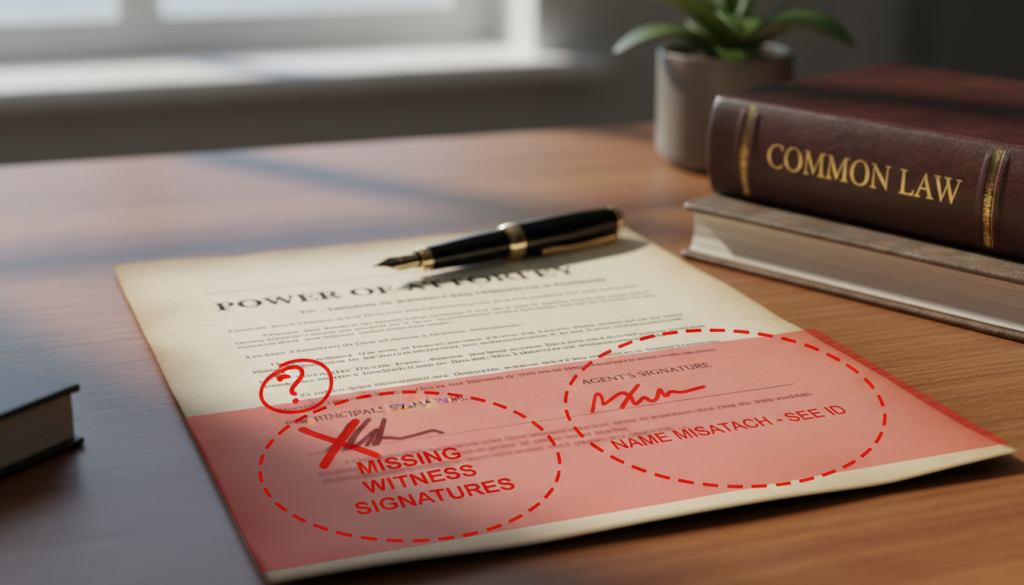
Power of Attorney Translation: Common Mistakes in Signature Sections
A power of attorney can appear straightforward until you reach the bottom half of the page, where many otherwise solid translations can falter. While the body text may read smoothly, if the signature section, witness block, notarial wording, dates, seals, initials, or handwritten additions are handled loosely, the entire document can be called into question. For official submissions, this can be a costly place to make a “small” mistake. Foreign-language documents submitted to U.S. authorities typically require a complete English translation along with a signed statement from the translator. It’s also important to note that certified translations are often incorrectly discussed as if the translation itself is notarized. Additionally, power of attorney execution rules can vary by jurisdiction, with notary and witness requirements differing by state or authority.
In practice, the highest-risk lines in a power of attorney are rarely the headline clauses. They are the lines that identify who signed, in what capacity, before whom, on what date, with what witness information, and under what notarial language. If any of these elements are incomplete, normalized, “cleaned up,” or reformatted too aggressively, the translation can stop looking like a faithful legal record and start resembling an edited version of one.
If your power of attorney is being prepared for immigration, a court filing, a real estate transaction, a bank review, or cross-border corporate use, the safest approach is simple: submit the full document, every page, every seal, every margin note, and every signature block for review before translation begins.
Why Signature Sections Cause More Problems Than the Main Text
A signature section is dense with legal meaning and often contains:
- The principal’s signature line
- The agent or attorney-in-fact identification
- One or more witness lines
- Printed names and addresses
- Date and place of execution
- Notarial acknowledgments or jurats
- Registration numbers, stamp text, and official seals
- Initials, handwritten corrections, or marginal notes
The challenge is that many of these items do not behave like ordinary prose. They are layout-sensitive, role-sensitive, and jurisdiction-sensitive. A translator cannot treat them as decorative footer material; they must be preserved as evidence.
This is especially crucial with power of attorney documents because the execution formalities may matter as much as the authorization language itself. In some jurisdictions, the signature must be notarized, while in others, witnesses may be required. In certain contexts, both the wording and the signatory roles need to remain visible exactly as executed.
The Signature-Section Audit That Prevents Most Avoidable Errors
Before translating a power of attorney, conduct a quick audit of the signature area:
- Who is signing? Principal, agent, substitute agent, witness, notary, certifying officer, interpreter, or registrar.
- What is each person’s role? The role should be translated accurately, not guessed from appearance.
- What must stay visually separate? Signature lines, printed-name lines, date fields, witness details, and notarial text should not be merged.
- What is handwritten, stamped, or sealed? These items need to be accounted for, even when partly illegible.
- What is blank? Blank lines matter as they indicate what was not completed at signing.
- What is jurisdiction-specific? Notarial formulas, witness requirements, and execution wording should be translated faithfully, not replaced with a generic English equivalent.
This single audit can catch most of the problems that lead to rejected or questioned translations.
The Most Common Power of Attorney Translation Mistakes
1) Confusing the Legal Role of the Signer
One of the easiest mistakes is translating a title in a way that changes its legal function. Terms like “attorney-in-fact,” “agent,” “principal,” “grantor,” and “mandatary” are not interchangeable just because they sound similar in ordinary English.
A common error occurs when a translator opts for the closest familiar word instead of the legally correct role. In a power of attorney, this can alter who is authorizing power and who is receiving it.
Safer approach: Translate the role precisely, then maintain that role consistently in every clause, signature label, and notary block.
2) Omitting Witness Details Because They Look Secondary
Witness names, addresses, ID references, printed names, and signatures are often squeezed into small spaces, making them easy to overlook, especially on scans with low contrast.
However, witness information is not filler. If the source document contains witness details, the translation should reflect them clearly. Removing them, partially translating them, or hiding them inside a generic note weakens the documentary trail.
Safer approach: Reproduce each witness line separately and identify printed-name fields, signature fields, and any witness notes in the order they appear.
3) Replacing the Notarial Wording with a Simplified Summary
A notarial block is not a place for paraphrase. Phrases like “signed before me,” “acknowledged before me,” and other notarial language may be crucial.
Many weak translations condense a full acknowledgment paragraph into a short line such as: “Notarized before an official.” While this may read neatly, it strips out content that the receiving authority may require.
Safer approach: Translate the full notarial wording, preserve line breaks where possible, and describe seals or stamps in brackets when needed.
4) Cleaning Up the Layout So Much That the Record Changes
In legal translation, tidy formatting is beneficial, but re-engineering the document is not.
If three separate signature lines become one paragraph, if a witness block is merged into a footnote, or if printed names and dates are moved away from the signatures they belong to, the translation stops mirroring the source. This creates friction for reviewers who compare the source and translation line by line.
Safer approach: Keep the translated signature section visually parallel to the original, even if that means using labels such as:
- Signature:
- Printed name:
- Witness 1:
- Witness 2:
- Date:
- Notary acknowledgment:
- Seal:
5) Ignoring Handwritten Insertions and Initials
Power of attorney documents often contain handwritten names, dates, check marks, initials, corrections, or interlineations. These details are not optional.
If a handwritten limitation appears near a signature, or initials appear beside a correction, that may affect how the document is interpreted. A translation that silently omits those details can misrepresent the executed version of the document.
Safer approach: Clearly note handwritten content and distinguish between typed text and handwritten additions where relevant.
6) Treating Stamps and Seals as Decorative Instead of Textual
A raised seal, rectangular registration stamp, round notary seal, or embossed mark may contain key information such as jurisdiction, office, license number, commission expiry, filing office, or registration date.
Even when a seal is partly unreadable, the presence of the seal itself should be recorded.
Safer approach: Include bracketed descriptions such as:
- [Round notary seal, partly illegible]
- [Embossed seal]
- [Registry stamp with number]
- [Blue ink stamp, text partly unreadable]
7) “Correcting” Names, Dates, and Numbers
This is one of the most dangerous mistakes in any legal translation.
If the source states 03/04/2024, the translator should not silently decide whether that means March 4 or April 3 unless the format is unmistakable from context. The same applies to passport numbers, national ID numbers, registration references, and address formatting.
A translator’s job is to reflect the record, not improve it.
Safer approach: Preserve the source data exactly, and where ambiguity exists, reflect the ambiguity or explain it with a neutral translator note instead of guessing.
8) Failing to Mark Illegible or Partially Visible Text
Blurry scans are common with power of attorney files sent via email or mobile phone. When parts of the signature section cannot be read, pretending otherwise is worse than flagging the issue.
Safer approach: Use transparent bracketed notes such as:
- [Illegible signature]
- [Text partly cut off]
- [Last name unclear]
- [Stamp unreadable]
This preserves honesty and helps the client decide whether a clearer scan is needed before filing.
9) Mixing Up Certified, Notarized, and Apostilled Requirements
Clients often use these terms interchangeably, but they are not the same thing.
A certified translation usually involves a signed statement from the translator or translation provider about completeness and accuracy. A notarized translation request typically refers to the notarization of the certification statement or the signer’s identity, not the notarization of the translated wording itself. An apostille is a separate authentication mechanism for public documents used across borders in countries covered by the Hague framework.
If the translation team misunderstands this chain, the signature section is often where the confusion becomes apparent.
What a Well-Handled Signature Section Looks Like
A strong translation of a power of attorney signature area usually:
- Mirrors the source layout closely
- Keeps each signer and witness on a separate line
- Translates role labels accurately
- Preserves dates, IDs, and reference numbers exactly
- Translates full notarial wording instead of summarizing it
- Records stamps, seals, and embossed marks
- Flags illegible items honestly
- Keeps blank fields visible where they exist
- Avoids mixing translator notes into the source text
This approach does not make the page look flashy; it makes it dependable.
A Practical Example of the Right Approach
Instead of compressing everything into one sentence, a careful translation may present the closing section like this:
- Principal:
- Signature: [signature]
- Printed name: Maria Elena Ruiz
- Date: 14 September 2025
- Witness 1:
- Signature: [signature]
- Printed name: Jorge Alvarez
- Witness 2:
- Signature: [signature]
- Printed name: Sofia Mendes
- Notary acknowledgment: [Full translated notarial wording here]
- Seal: [Round notary seal, commission text partly illegible]
This kind of presentation helps a reviewer quickly confirm that the translated record still matches the executed document.
What to Send Before Requesting a Power of Attorney Translation
To reduce delays, send:
- Every page of the power of attorney
- All attachments, back pages, and registry pages
- Clear scans of signatures, seals, and stamps
- Any cover page or legalization page
- Instructions on where the translation will be filed
- Confirmation of whether certification, notarization, or apostille support is needed
For U.S. filings, complete translation matters. For cross-border legal use, execution and authentication details may matter just as much. A simple note to the translator can prevent unnecessary revision rounds:
Please preserve all witness lines, notarial wording, seals, handwritten notes, blank fields, and signature labels exactly as shown.
When a Rushed Translation is Most Likely to Fail
Power of attorney translations become high-risk when:
- The scan is cropped at the bottom
- Only the first page is sent
- The client sends the typed pages but not the notarized page
- Witness names are faint or handwritten
- The receiving authority has specific execution or authentication rules
- The translator is asked to “clean up” the legal formatting for readability
Readable English is helpful, but executed-document fidelity is more important.
A Better Standard for Power of Attorney Translation
The right standard is not “Does this sound natural?” The right standard is: Does this preserve the legal record without adding, removing, normalizing, or guessing?
This is why the signature section deserves its own review pass. On a power of attorney, the final inch of the page often carries the most risk. If your document is headed to a court, consulate, immigration authority, bank, title company, or foreign registry, send the full file first and have the signature section checked before the translation is finalized. This step is cheaper than a rejection, faster than a rework, and far safer than filing a document whose most sensitive lines were simplified on the way into English.
“Their expertise in translating complex legal documents helped our firm win critical litigation cases.” (24 Hour Translation Services)
Frequently Asked Questions
Does a power of attorney translation need to include the signature section?
Yes. If the signature section appears on the source document, it should normally appear in the translation as well, including witness lines, dates, notarial wording, and any visible seals or stamps. For official submissions, partial treatment of the signature area creates avoidable risk.
What are the most common power of attorney translation mistakes?
The most common power of attorney translation mistakes include inaccurate role terms, omitted witness details, summarized notarial wording, changed formatting, dropped seals or stamps, guessed dates, and failure to mark illegible text.
Is a certified translation the same as a notarized translation?
No. A certified translation usually includes a signed accuracy statement from the translator or provider. A notarized translation request typically means the signer’s certification statement is notarized; it does not mean the notary is certifying the translation content itself.
Do witness and notarisation requirements change by jurisdiction?
Yes. Power of attorney execution rules can vary depending on the state, court, or receiving authority. Some require notarization, some allow or require witnesses, and some impose additional conditions for specific document types or uses.
Should a translator describe stamps and seals in brackets?
Yes. If a stamp, seal, embossment, or registration mark is visible, it should usually be described or translated as far as legible rather than ignored.
When does apostille matter for a power of attorney?
Apostille matters when the receiving country or authority requires authenticated public or notarized documents for cross-border use. It is separate from the translation itself and should be confirmed before filing.