
If you have been told you need a notarised translation, the most important question is not “Who can stamp this?” It is “What is the receiving authority actually asking a notary to confirm?”
That matters because many people pay for the wrong level of certification.
In plain English, a notarised translation is usually a certified translation that has gone through an extra legal step with a notary public. The notary normally verifies the identity of the person signing the translator’s statement or affidavit, authenticates the signature or declaration, and adds a seal or notarial certificate. What the notary does not usually do is sit there checking every translated sentence word by word.
For many UK submissions, a properly certified translation is enough. Notarisation tends to become relevant when a foreign authority, embassy, overseas court, international business transaction, or cross-border legal process wants an extra layer of formal authentication.
Need a fast answer before you order the wrong service? Send 24 Hour Translation the document and the name of the authority receiving it. That lets the team tell you whether certified translation is enough, or whether you also need notarisation or apostille.
The plain-English answer
Here is the simplest way to think about it:
- Certified translation = the translator or translation company confirms the translation is accurate.
- Notarised translation = a notary public formally verifies the signature, declaration, or affidavit attached to that translation.
- Apostille / legalisation = a further step used when a foreign authority wants official confirmation of the notary’s signature or seal.
That is why people get confused. These are not three words for the same thing. They are three different levels of formality.
The expensive mistake is rarely buying “too little translation.” It is buying the wrong certification for the authority in front of you.
What a notarised translation actually is
A notarised translation usually starts life as a standard certified translation.
The translator completes the translation, prepares the certification wording, and signs the declaration. After that, a notary public may witness the translator’s signature, verify the identity of the signatory, or notarise a supporting affidavit or declaration linked to the translation.
The end result is a pack that carries:
- the translated document
- the certification statement
- the translator’s or authorised signatory’s signature
- the notary’s signature, seal, and notarial wording where required
That extra layer is what makes it “notarised.”
What a UK notary actually verifies
This is the part most pages explain badly.
A UK notary is usually verifying the formal legal act around the translation, not automatically the wording of the translation itself.
In practice, a notary may verify:
1. The identity of the person signing
The notary checks who is signing the translator’s declaration, affidavit, or verification statement.
2. The authenticity of the signature
The notary witnesses or authenticates the signature attached to the certification wording.
3. The form of the declaration
The notary checks that the declaration, affidavit, or verification is properly made for the purpose required.
4. The legal formality of the notarial act
The notary applies the official seal, signature, date, and notarial wording needed for onward use.
5. In some cases, that the person understands what is being signed
If the underlying document or notarial step involves foreign-language material, the notary may insist on a proper translation, an interpreter, or both before proceeding.
This is why people dealing with overseas powers of attorney, company packs, embassy instructions, or foreign court documents often end up needing both a translation provider and a notary.
What a UK notary usually does not verify
This is just as important.
A notary does not usually confirm:
- that every translated word is correct purely because a seal has been added
- that the receiving authority will definitely accept the document
- that notarisation is enough if the authority also wants apostille or consular legalisation
- that the facts inside the original document are true
- that notarisation is always required just because the document is “official”
That last point matters. Official-looking documents often need only certified translation, not notarisation.
Certified, notarised, and apostilled: the difference that saves time and money
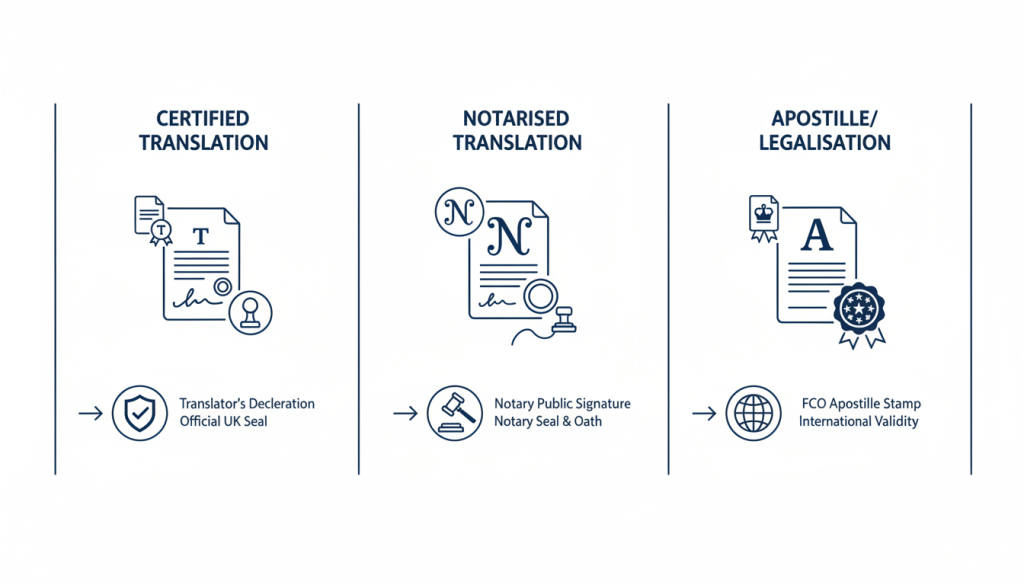
Certified translation
This is the normal starting point for official translation work in the UK. It is commonly used for immigration, academic, legal, and business submissions where the authority wants an accurate translation with identifiable certification.
A certified translation usually includes:
- confirmation that the translation is accurate
- the date
- the translator’s name and signature
- contact details for the translator or company
Notarised translation
This is the next level. It adds a notary public to verify the formal signing process around the translation.
This is more likely to be needed when:
- an overseas authority asks specifically for notarisation
- an embassy or consulate asks for a notary public
- a foreign court or civil-law process requires stronger formal authentication
- company or legal documents are being prepared for use abroad
Apostilled or legalised translation pack
This is the next step after notarisation in many international cases.
If the receiving country asks for an apostille, the translation pack or related notarised document is sent for legalisation. This confirms the notary’s signature, stamp, or seal so the document can be recognised abroad.
When notarisation is usually needed
There is no single universal list, because the real rule is always: follow the receiving authority’s exact wording.
That said, notarisation is commonly requested for:
Overseas powers of attorney
If you are authorising someone abroad to act for you, the foreign authority may require a translated document with notarisation and sometimes apostille.
Embassy and consular submissions
Some embassies and consulates want documents translated, certified, and then notarised before they will accept them.
Foreign court or legal proceedings
Where a translated document will be used in litigation, probate, contractual disputes, or formal legal filings abroad, a notary may be part of the required chain.
Company and corporate documents for foreign use
This is a major area people overlook. Documents such as:
- certificates of incorporation
- articles of association
- board minutes
- shareholder resolutions
- powers of attorney
- certificates of incumbency
- commercial agreements
may need translation plus notarisation when they are being submitted overseas.
Specialist checks or tightly worded official requests
Sometimes the wording from the receiving body is highly specific. If it mentions a notary public, notarisation, legalisation, affidavit, or apostille, do not assume a normal certified translation will be enough.
When certified translation is often enough
This is the part many people need to hear.
For many UK-facing processes, the authority is looking for a certified translation, not a notarised one.
That often includes:
- visa and immigration supporting documents
- sponsor and business immigration evidence
- personal civil documents for UK use
- many academic submissions
- many employer, solicitor, or professional review packs
- many standard legal or administrative submissions where no notary is specifically requested
So if your document is staying inside a UK process, certified translation is often the correct place to start.
That does not mean “always.” It means you should not pay for notarisation just because the document feels important.
The three-question test before you order anything
This is the quickest way to avoid delay.
Question 1: Where is the document going?
UK authority, foreign authority, embassy, court, employer, university, notary, or overseas regulator?
Question 2: What exact words does the instruction use?
Look for wording such as:
- certified translation
- notarised translation
- notary public
- apostille
- legalisation
- sworn translation
- affidavit
- original plus translation
Question 3: Are they authenticating the translation, the signature, or the document itself?
That is where people go wrong. Sometimes the authority wants confidence in the translation. Sometimes it wants a formal witness to a declaration. Sometimes it wants the notary’s seal to be legalised for international use.
If you answer those three questions first, you are much less likely to pay twice.
A realistic step-by-step process
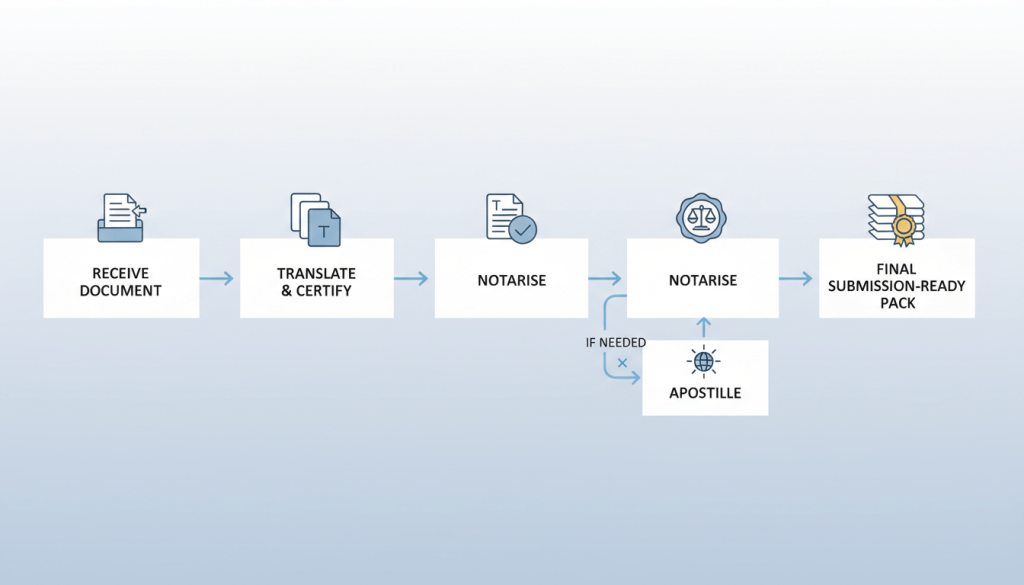
At 24 Hour Translation, a notarised case should be handled in the right order, because the sequence matters.
Step 1: Check the requirement before translating
The authority wording should be reviewed first. This decides whether you need:
- certified only
- certified plus notarised
- certified plus notarised plus apostille
- a different route altogether, such as sworn translation in another jurisdiction
Step 2: Prepare the translation properly
The translation should be complete, clearly formatted, and matched to the source document. Names, dates, reference numbers, stamps, seals, handwritten notes, and layout elements should be handled carefully.
Step 3: Add the certification statement
The translator or company prepares the formal certification wording and signs it.
Step 4: Arrange notarisation if required
The translator’s declaration, affidavit, or verification is then taken through the notarial step.
Step 5: Arrange apostille or consular legalisation if required
If the destination country asks for it, the notarised pack moves on for legalisation.
Step 6: Deliver a submission-ready pack
The final pack should be organised so the recipient can understand it immediately, rather than receiving a loose stack of unrelated pages.
Need the whole route handled without chasing separate providers? Upload the file once and let 24 Hour Translation advise on the correct path from the start.
Common mistakes that cause rejection or wasted spend
Ordering notarisation “just in case”
This sounds safe, but it often adds cost and time without adding value.
Confusing notarisation with apostille
A notarised translation and an apostilled translation pack are not the same thing.
Assuming a notary guarantees the translation text
The notary’s role is legal authentication, not automatic linguistic review.
Translating only part of the pack
A receiving authority may want the full relevant document set, not just the page that looks important to you.
Using poor-quality scans
Bad scans create risk around names, numbers, signatures, and stamps.
Waiting until the last day
Notarisation and legalisation can add steps. When the deadline is tight, the correct route matters even more.
Typical real-world scenarios
Scenario 1: UK visa supporting documents
A client has a birth certificate, bank statement, and marriage certificate in another language for a UK application. In many cases, a properly certified translation is enough. Paying for notarisation first would often be unnecessary.
Scenario 2: Power of attorney for use abroad
A client needs a translated power of attorney for a property or legal matter overseas. The receiving authority may ask for certification, notarisation, and apostille in that order.
Scenario 3: Company documents for foreign registration
A UK business is sending articles, incorporation documents, and board minutes overseas. This is exactly the kind of cross-border corporate case where notarisation becomes more likely.
Scenario 4: Embassy pack with precise wording
The embassy instruction says “translation to be certified by a notary public” or asks for notarised copies. In that case, the wording should be followed literally rather than guessed.
Why this matters for business and legal documents

Personal documents are only half the story.
Notarised translation is especially relevant in business because overseas corporate processes often care about formality, chain of authentication, and who is confirming what.
For example, when a translated company pack includes articles of association, shareholder resolutions, or board minutes, the receiving authority may want reassurance not only that the document is translated, but that the certification and signing process around it has been formally authenticated.
That is why plain-English guidance matters. The question is not whether the document is “important.” The question is whether the receiving body wants:
- a translator’s certification
- a notary’s authentication
- an apostille on the notary’s act
- all of the above
A better way to decide: start with the authority, not the document
Most online advice starts with the document type.
A better way is to start with the destination authority.
The same birth certificate might need:
- certified translation for one UK process
- certified plus notarised for one embassy
- certified plus notarised plus apostille for another country
The same applies to contracts, powers of attorney, company records, academic papers, and court documents.
So the smartest first move is not “find the cheapest stamp.” It is “match the certification level to the exact receiving requirement.”
How 24 Hour Translation helps keep the process simple
When a client asks for notarised translation, the real value is not just producing the translated pages. It is preventing the wrong route.
24 Hour Translation helps by:
- reviewing the wording from the receiving authority
- preparing certified translations suitable for official submission
- coordinating notarisation where required
- supporting legal, immigration, academic, and corporate document packs
- helping clients move from translation to submission without unnecessary back-and-forth
For urgent cases, it is especially useful to sort the certification level at the beginning. A fast translation is only helpful if it is the right one.
Final word
A notarised translation is not “a better certified translation.” It is a certified translation that has passed through an extra legal authentication step.
In plain English, the notary usually verifies the signature, declaration, and formal legal act around the translation. The notary does not automatically verify every translated word.
That is the distinction that saves money, time, and rejection risk.
If you are unsure whether you need certified translation, notarisation, apostille, or a full international document pack, send the file and the receiving authority details to 24 Hour Translation first. It is the quickest way to avoid ordering the wrong service.
FAQs
What is a notarised translation in the UK?
A notarised translation in the UK is usually a certified translation that has gone through an additional step with a notary public. The notary verifies the signing or declaration attached to the translation and applies official notarial authentication.
What is the difference between certified and notarised translation?
A certified translation confirms the translation is accurate. A notarised translation adds a notary public who formally verifies the signature, declaration, or affidavit attached to that certification.
Does a notary public verify the translation itself?
Not usually. In most cases, the notary verifies the identity of the signatory and the legal formality of the signed declaration. The notary does not automatically re-check every translated sentence.
Do UK immigration applications need notarised translation?
Many UK immigration-related submissions require a properly certified translation rather than notarisation. The safest approach is always to check the exact wording of the current authority guidance or submission instruction.
When is notarisation more likely to be needed?
Notarisation is more likely when documents are going to an overseas authority, embassy, foreign court, or international corporate process, especially where the instructions specifically mention a notary public.
Do I need apostille after notarised translation?
Sometimes. If the destination country asks for legalisation or apostille, notarisation may only be one stage in the process. The apostille is the step that confirms the notary’s signature or seal for international recognition.