Employment Letter Translation: HR-Friendly Layout That Still Stays Accurate
When an employer, recruiter, immigration officer, payroll team, or compliance reviewer opens a translated work letter, they want two things at once: clarity and fidelity. That is why the right employment letter translation format matters so much. A good translation should feel easy to read, yet still reflect the original document line by line where it counts most—job titles, duties, salary lines, dates, signatures, stamps, and company details.
The biggest mistake is assuming that a cleaner layout means a freer rewrite. It does not. Employment letters are often short, but they carry decision-making details that affect hiring, visa files, background checks, compensation review, onboarding, mortgage applications, and professional licensing. If the translated version smooths over the original too aggressively, even small changes can create doubt.
A better approach is simple: make the document HR-friendly without changing what the source actually says. That means preserving structure, clarifying formatting, and handling terminology with discipline. If you need your employment letter prepared for formal review, upload your file to 24 Hour Translation and get a version that is readable, complete, and professionally formatted from the start.
Why Employment Letter Translations Are Often Questioned
Employment letters look straightforward, but they are packed with risk points. Reviewers tend to slow down when they see any mismatch in the following areas:
- Job title wording that sounds more senior or less senior than the original
- Duties that have been summarized too aggressively
- Salary lines that lose the difference between gross, net, monthly, annual, base pay, or allowances
- Dates that become ambiguous after conversion
- Missing letterhead, reference numbers, stamps, or signatures
- Layout changes that hide what appeared where in the original
In practice, a translation is easiest to trust when the reviewer can follow the source document’s logic without struggling through a cluttered page.
The Format Rule That Works: Mirror First, Simplify Second
The best employment letter translation format follows one principle: mirror the source where facts matter. Simplify only where readability improves. That means the translation should keep the same factual structure while making the page easier for an English-speaking reviewer to scan.
What Should Usually Stay in the Same Place
- Company name and letterhead details
- Document date
- Addressee or “To Whom It May Concern” line
- Subject or reference line
- Employment confirmation paragraph
- Job title and department
- Employment start date and status
- Duties or scope of work
- Salary and compensation lines
- Closing statement
- Name, signature block, stamp, seal, or official note
What Can Be Improved for Readability
- Line spacing
- Font consistency
- Clearer paragraph breaks
- Table cleanup when the original is visually messy
- Label alignment for salary, dates, and position details
- Brief translator notes only when something would otherwise be unclear
This is the difference between a translation that merely “sounds natural” and one that is actually safe to submit.
The Reviewer-Friendly Structure to Use
A strong employment letter translation format usually follows a three-layer structure.
1. Visual Fidelity
The translation should resemble the source document enough that a reviewer can compare sections quickly.
2. Information Hierarchy
Key facts should be easy to spot at a glance: employee name, employer name, job title, dates, duties, and salary.
3. Certification Layer
If the destination requires a certified translation, the translated letter should be paired with the appropriate certification statement rather than blending certification wording into the document body. This keeps the employment letter itself clean while preserving the official support paperwork separately.
What Each Critical Field Should Look Like in Translation
| Source Element | Best Way to Present It | What to Avoid |
|---|---|---|
| Company Name | Keep legal company name exactly as shown; translate only generic descriptors if appropriate | Rebranding or shortening the company name |
| Employee Name | Match passport or ID spelling where relevant, while preserving the source spelling if different | “Correcting” the person’s name without basis |
| Job Title | Translate the role accurately by function and level | Inflating or downgrading seniority |
| Duties | Preserve scope, sequence, and responsibility level | Summarizing into vague HR language |
| Salary Lines | Keep amount, currency, pay period, and labels clear | Currency conversion or assumption-based rewriting |
| Dates | Render clearly and consistently, especially if the source format is ambiguous | Silently changing day/month order |
| Signatures and Stamps | Keep visible signature blocks and describe stamps if needed | Omitting non-text elements |
| Reference Number | Retain exactly as shown | Reformatting or deleting document codes |
Job Titles: Translate Function, Not Prestige
Job titles cause more problems than many people expect. A reviewer may not know the source language, but they can still notice when the translated title feels inconsistent with the rest of the document. For example, a title should not become more impressive just because the translator is trying to make it sound polished. “Assistant,” “Officer,” “Coordinator,” “Executive,” “Supervisor,” “Manager,” and “Director” are not interchangeable. Neither are technical titles and administrative ones.
A Safer Rule for Job Title Translation
Translate the title to reflect:
- Actual level of responsibility
- Department context
- Whether it is operational, technical, supervisory, or managerial
- Whether it is a formal title or a descriptive role
If the source title has no exact English equivalent, the translation should choose the closest functional match and avoid marketing-style upgrades.
Example
Risky version: “Senior Management Executive”
Safer version: “Senior Administrative Officer”
The second version may be less flashy, but it is far more likely to match the source and the employee’s duties.
Duties Must Stay Specific
Employment letters often include a short list of responsibilities. This is where many translations become too general. A duty list like this:
- Preparing monthly payroll
- Managing staff attendance records
- Coordinating supplier payments
- Preparing internal reports
Should not become:
- Handling administrative tasks
- Supporting business operations
That kind of summary may sound tidy, but it removes the detail that decision-makers use to evaluate a role.
Keep These Duty Details Intact
- Action verbs
- Reporting scope
- Staff supervision references
- Finance or compliance responsibilities
- Tools, systems, or departmental context
- Frequency markers such as daily, monthly, quarterly
If the original says the employee “prepared monthly payroll reports and reconciled attendance data,” the translation should preserve both actions. Do not compress them into one vague sentence.
Salary Lines Must Be Handled with Almost Zero Interpretation
Salary information is one of the most sensitive parts of an employment letter translation. Reviewers may compare the translated letter with bank statements, payslips, tax documents, visa forms, or contract records. Any inconsistency stands out immediately.
Salary Lines Should Preserve
- Exact amount
- Currency
- Gross or net label
- Monthly, annual, weekly, or hourly period
- Allowances or bonuses
- Deductions if mentioned
- Wording such as “base salary,” “total compensation,” or “including housing allowance”
Never Do These
- Convert currency unless the source already includes a converted figure
- Round amounts for neatness
- Merge salary and allowance lines into one figure
- Switch “monthly” to “annual” for convenience
- Replace “gross” with “net” or vice versa
Example of a Safe Salary Rendering
Source meaning: Base salary: AED 12,500 per month
Transport allowance: AED 1,000 per month
Total monthly gross compensation: AED 13,500
Safe translation layout: Base Salary: AED 12,500 per month
Transport Allowance: AED 1,000 per month
Total Monthly Gross Compensation: AED 13,500
That format is easy for HR teams to review and still faithful to the source.
Dates Should Become Clearer, Not Different
Date formatting is one of the most common causes of avoidable confusion. A reviewer may not know whether 03/04/2024 means 3 April or March 4. A translator should solve the readability issue without altering the underlying date.
Best Practice for Dates
- Write out the month when ambiguity exists
- Keep issue date, start date, end date, and letter date clearly distinct
- Preserve historical dates exactly as they appear in meaning
- Use a translator note only when the original is genuinely unclear
Safer Presentation Example
Instead of: 03/04/2024
Use: 03 April 2024
If the source is ambiguous and certainty is impossible, note that carefully rather than guessing.
Layout Details That Still Matter: Letterhead, Stamps, Signatures, and Seals
An HR-friendly layout does not mean stripping away document features that look decorative. In employment letters, those features can help prove authenticity. Keep or account for:
- Company letterhead
- Logo area if present
- Reference or file number
- Official stamp or seal
- Signer’s printed name
- Signer’s title
- Handwritten note or amendment
- Page numbering if multiple pages exist
If text appears inside a stamp or seal and it is readable, translate it. If it is not fully readable, note that honestly. Do not pretend a stamp is irrelevant just because it is not part of the main paragraph text.
A Practical Template for a Clean Translated Employment Letter
Below is the kind of structure that works well for most translated employment letters:
[Company Name]
[Company Address / Letterhead Details if shown in source]
Date: [Translated date]
Subject: Employment Confirmation for [Employee Name]
To Whom It May Concern,
This letter confirms that [Employee Name] has been employed by [Company Name] as [Job Title] since [Start Date].
The employee works in the [Department / Division] and is responsible for the following duties:
[Duty 1]
[Duty 2]
[Duty 3]
The employee’s [base salary / total salary / gross monthly salary] is [Amount and Currency], with the following additional compensation if stated in the source:
[Allowance / bonus / transport / housing]
[Other compensation lines]
This letter has been issued at the employee’s request for official use.
Sincerely,
[Signer Name]
[Signer Title]
[Signature / Stamp note if present]
That structure is readable, formal, and still close enough to the original for efficient comparison.
A Useful Rule for Bilingual Formatting
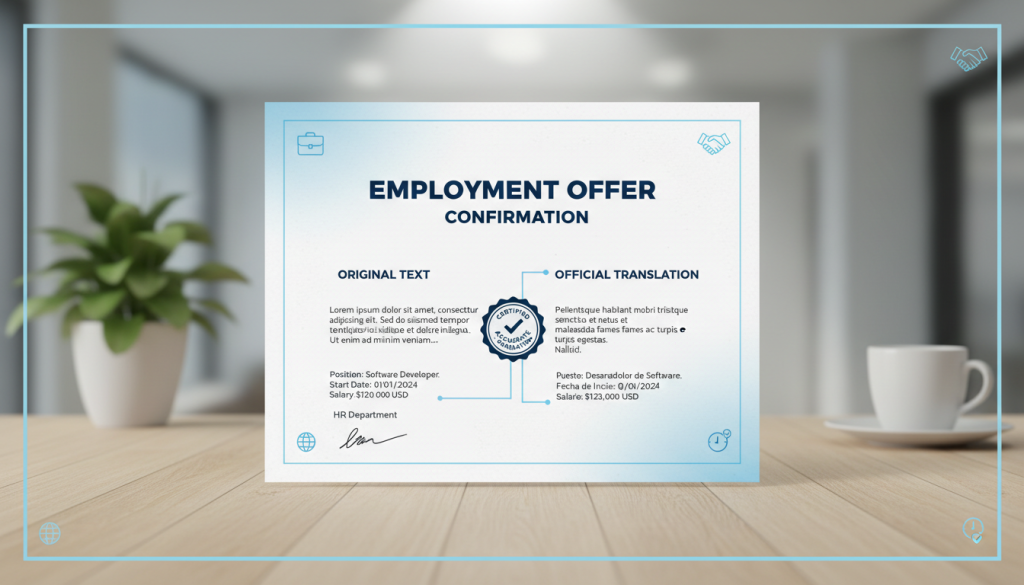
For employment letters, the safest presentation is usually full translated text in a clean English layout, not a sentence-by-sentence bilingual mashup. However, if a client or authority specifically wants side-by-side comparison, a bilingual table can be effective for short letters.
A Side-by-Side Format Is Most Useful When:
- The original contains short blocks of text
- HR or legal reviewers want quick comparison
- The document includes brief duties or salary tables
- Terminology needs transparent mapping
A Clean Monolingual Translated Format Is Best When:
- The letter is longer or paragraph-based
- The recipient wants a polished submission copy
- The destination authority expects a standard translated document
- Certification will be attached separately
What a Good Translator Checks Before Delivery
A reliable employment letter translation is not finished when the last sentence is translated. It is finished after a document-level check.
Final Review Checklist
- Employee name matches the source exactly
- Company name is consistent across header, body, and sign-off
- Job title matches the duties
- Department name is translated consistently
- All dates are clear and internally consistent
- Salary lines keep the same amount, currency, and frequency
- Duties are complete, not selectively shortened
- Stamps, signatures, and reference numbers are accounted for
- All pages are included
- Certification wording matches the intended use
This last step is where many preventable problems get caught.
A Quick Case-Style Example
A translated employment letter can look elegant and still fail review if it hides key facts. One common scenario is a translator who rewrites a two-paragraph employment confirmation into a polished one-paragraph English letter. It reads well, but it quietly removes the transport allowance, condenses the employee’s responsibilities, and changes the job title from coordinator level to manager level. The result is smoother English but weaker evidence.
A stronger version keeps the original facts visible, separates duties clearly, preserves the salary structure, and maintains the signer block. Reviewers spend less time questioning it because they can see the logic of the original document. That is the real goal: not just readable English, but review-ready accuracy.
When Certification May Also Matter
Some employment letters are used informally inside companies. Others are submitted to immigration authorities, educational institutions, licensing bodies, courts, lenders, or government offices. In those situations, the translated format is only part of the requirement. The certification package may matter too.
A complete submission often works best when it includes:
- The original document copy
- The full translation
- The certification statement
- Notarization only if the receiving authority specifically asks for it
If your employment letter is being used for official purposes, it is worth confirming the end-user requirement before the translation is finalized. If you are unsure, send the destination requirements with your file and 24 Hour Translation can prepare the format accordingly.
Why This Matters for Employers, Employees, and HR Teams
A strong employment letter translation format helps all sides. For employees, it reduces the chance of rejection or follow-up questions. For employers and HR departments, it presents the company professionally and avoids confusion around titles, salary, and role scope. For reviewers, it makes the document easier to trust.
That is why the best translations do not choose between “accurate” and “easy to read.” They do both. If your letter includes complex duties, payroll language, allowances, signatures, or unusual formatting, send it in as-is. A professional review can preserve the original meaning while turning it into a cleaner, more submission-friendly document.
Need Your Employment Letter Translated Without Losing HR Clarity?
24 Hour Translation handles employment letters, work certificates, salary confirmations, and supporting business documents with a format-first review process. That means checking titles, duties, salary lines, dates, and document structure before delivery—not after a problem appears.
Upload your file, include the country or organization where you will submit it, and request a certified version if needed. It is the fastest way to get a translation that reads clearly and holds up under scrutiny.
Frequently Asked Questions
What is the best employment letter translation format?
The best employment letter translation format keeps the original facts and structure intact while making the translated version easier for the reviewer to scan. It should clearly present the company name, employee name, job title, duties, salary lines, dates, and signature details without rewriting the substance.
Should job titles be translated literally in an employment letter?
Not always. Job titles should be translated by function and level, not by word-for-word appearance alone. The goal is to reflect the actual role accurately without inflating seniority or weakening responsibility.
How should salary lines appear in a translated employment letter?
Salary lines should preserve the original amount, currency, pay period, and labels such as gross, net, base salary, or allowance. A translator should not convert currency, round figures, or combine separate compensation lines unless the source does so.
Can duties be shortened in an employment letter translation?
Only with extreme caution. In most official or review-based uses, duties should remain specific. Shortening them too much can make the role appear different from the source document and raise questions about accuracy.
How should dates be written in an employment letter translation?
Dates should be made clear for the target reader, especially when the source format is ambiguous. Writing out the month is often the safest option, provided the meaning of the original date is preserved.
Do I need a certified translation for an employment letter?
That depends on where the letter will be submitted. Many official uses require a complete translation plus a signed certification statement. It is best to check the receiving authority’s requirements before ordering.