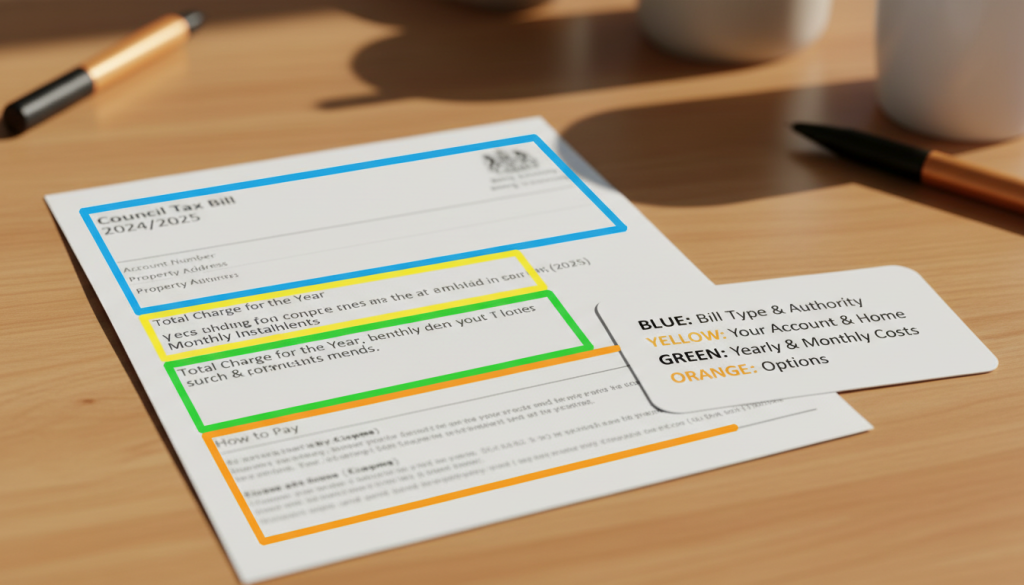
A council tax bill translation is not just about turning one language into another. It is about making the bill readable, verifiable, and acceptable for official use without altering what the original document actually says.
That matters because council tax bills are often used to support proof of address, identity checks, immigration packs, tenancy files, banking requests, school admissions, and overseas administrative applications. If the translation smooths out details that should stay exact, such as address formatting, reference numbers, billing periods, or charge descriptions, it can create the very confusion the translation was meant to solve.
A strong translation does three things at once. It keeps the original meaning intact. It makes the important fields easy to follow. And, when required, it includes a certified statement that helps the receiving authority rely on the translation as a faithful version of the source document.
If you need a council tax bill translated for official use, send a clear scan first. The fastest projects are usually the ones where every field is visible from the beginning, including the full address block, the billing period, the account reference, and any notes about discounts, instalments, or changes to the account.
What a council tax bill translation is really supposed to do
The best translations of billing documents follow a simple rule: clarify, but do not rewrite.
That means the translation should help the reader answer five practical questions immediately:
- Who is responsible for the bill?
- Which property or billing address does it relate to?
- What period does the bill cover?
- What charges, reductions, or instalments are shown?
- How can the translated document be matched back to the original?
This is where many weak translations fall short. They translate the headline and the amount due, but leave the surrounding context vague. In official settings, that missing context is often what matters most.
A council tax bill can contain more than a single balance figure. It may show the tax year, the property band, the printed date, the reason the bill was issued, reductions or discounts, instalment dates, and the payment method. If those elements affect meaning, they should be translated clearly rather than assumed or summarised.
Need your bill reviewed before translation begins? Upload your file and ask for a visibility check first. A quick pre-check often catches cropped addresses, blurred totals, and missing reverse pages before they become a delay.
The sections that matter most in a council tax bill translation
1. Name of the liable person or company
This is often the first field the recipient checks. The translation should make it immediately clear who the bill is addressed to and who is responsible for payment.
If the name on the bill does not match the passport, bank file, tenancy record, or application form exactly, the translation should not hide that difference. It should reflect the document as issued. If necessary, that mismatch can be explained separately, but not silently fixed inside the translation.
2. Billing address and property address
One of the most common problems in council tax bill translation is the presence of two different addresses.
A bill may show:
- a correspondence or billing address
- the property address the council tax relates to
These are not always the same. A translation that merges them into one simplified address can create avoidable confusion. The safer approach is to label each address exactly as the original document does and keep the distinction visible.
3. Charges and periods
Charges and periods are central to meaning. A council tax bill may cover a full year, part of a year, or a revised period after a change to the account. It may also show instalments rather than a single lump sum.
That is why the translation should make the following easy to spot:
- total charge
- any reductions or exemptions shown
- balance due
- instalment schedule
- billing period or tax year
- issue date or print date
4. Reference numbers
Reference numbers should normally be reproduced exactly, not translated, reformatted, or “cleaned up.”
That includes:
- council tax account numbers
- property references
- payment references
- online keys or internal bill references
A receiving authority may use those identifiers to compare the translation with the original. Even a small formatting change can make that harder.
5. Address formatting and postcode handling
Address lines often look messy, especially when they include building names, flat numbers, blocks, stair numbers, local district references, or postcode formats unfamiliar to the target reader.
The translation should improve readability, but it should not normalise the address into a different postal style unless the recipient has specifically asked for that in a separate explanatory note.
Good practice is to preserve:
- the original order of address components where meaningful
- the postcode exactly as shown
- flat, unit, building, block, floor, and plot identifiers
- regional or municipal labels if they appear in the source
Charges and periods: make them readable without changing them
This is the point where accuracy matters most.
Many people think the amount is the only thing that counts. In reality, official reviewers often want to understand the timeline behind the amount. A translated council tax bill should show not only what is payable, but what period the figure belongs to.
For example, a bill may include:
- a yearly charge
- a revised charge after a move-in or move-out date
- a single person discount
- council tax reduction
- arrears carried forward
- credit brought forward
- instalment due dates
If the translation skips these details and shows only the final number, the reader may misread the financial picture.
A simple rule for financial sections
Translate labels. Preserve figures. Clarify relationships.
A clean approach looks like this:
| Bill element | Best handling in translation |
|---|---|
| Amount due | Reproduce exactly as shown |
| Discount or reduction | Translate the label clearly and keep the amount exact |
| Billing period | Translate fully, including from/to dates if shown |
| Instalments | Keep each due date and amount visible |
| Arrears or credit | Translate the label directly, without softening the wording |
| Reference number | Copy exactly, do not translate |
Where date or number conventions could confuse the reader, the safest solution is not to silently convert them. It is usually better to preserve the original figure exactly and, where needed, clarify the format in a brief translator note.
What should never be “fixed” in a council tax bill translation
A council tax bill translation is not the place to tidy the source document.
Do not silently change:
- names to match another document
- address order to look more familiar
- abbreviations that affect legal or postal meaning
- reference numbers
- account identifiers
- postcodes
- band labels
- date sequences
- amounts, currency symbols, decimal separators, or punctuation within reference fields
If the source contains an odd spelling, unusual layout, partial line break, or inconsistent formatting, the translation should reflect that faithfully while staying readable.
This is one reason professionally prepared translations are stronger than informal summaries. The job is not to improve the document. The job is to represent it accurately.
Reference numbers, bands, and labels: what gets translated and what stays unchanged
Some parts of a council tax bill are translated as language. Others are transferred as identifiers.
Translate these clearly
- headings
- charge descriptions
- discount labels
- instalment headings
- notes about changes to the account
- payment instructions where relevant to meaning
- explanatory notices affecting the status of the bill
Keep these exact
- account references
- property references
- postcodes
- band letters or classifications as printed
- dates and figures, unless the recipient requires an explanatory note
- internal codes and bill numbers
Use translator notes sparingly
Translator notes are useful when a literal rendering alone could confuse the reader. They are not a licence to add commentary everywhere.
Useful cases include:
- explaining that the bill shows both a billing address and a property address
- clarifying an unusual address component that has no direct equivalent
- noting that a number has been preserved exactly as printed
- identifying that a field is handwritten, stamped, or partially obscured on the source
When the bill has more than one page
Some of the most important meaning sits outside page one.
Additional pages may include:
- instalment schedules
- updated balances
- reduction notices
- explanatory notes
- payment breakdowns
- correspondence references
- change notices following occupancy updates
If those pages affect the meaning of the bill, they should be translated too. Translating only the cover page can work for some informal checks, but it is risky for official use if the missing pages explain the amount, the period, or the status of the account.
A good rule is this: if the receiving body needs the bill as evidence, translate every page that carries material meaning.
When only part of the bill is visible
A cropped scan is one of the biggest avoidable causes of rework.
Common issues include:
- the top line of the address cut off
- reference number blurred
- instalment table missing the last column
- page two omitted
- reverse side ignored even though it contains relevant notes
- shadow over the amount due or issue date
Before any council tax bill translation starts, check that the scan shows:
- all four corners
- every page
- clear figures
- readable names
- full address lines
- all stamps, notes, and side headings
Ready to start? Upload the bill exactly as received. A clear full-page image gives you a faster quote, fewer follow-up questions, and a cleaner final translation.
Do you need a certified statement?
For many official uses, yes.
A certified statement helps the receiving body understand that the translation is a faithful rendering of the original and that it can be linked to a responsible translator or translation company.
This is especially important where the bill is being used in:
- visa or immigration packs
- official address verification
- legal files
- school or university administration
- tenancy and compliance checks
- banking or cross-border due diligence
- foreign submissions that require document translation with formal identification of the translator
A certified council tax bill translation is not only about language quality. It is also about traceability.
What a certified statement should cover
A strong certification section usually includes:
- confirmation that the translation is accurate
- the date of translation
- the translator’s or translation company’s name
- signature or authorised sign-off
- contact details
Where the receiving body has its own requirements, the wording and presentation should follow those instructions closely.
Sample certification wording
I certify that this translation is a true and accurate translation of the attached document to the best of my professional knowledge and ability.
Date: [date]
Translator / Authorised Representative: [name]
Signature: [signature]
Contact Details: [company name, address, email, phone]
Common mistakes that cause delays
Even a good translation can run into problems if the document handling is careless. The most frequent issues are surprisingly small.
Mistake 1: Translating only the obvious fields
A bill is more than the amount and the address. Missing the reason for issue, the date printed, or the reduction notes can weaken the document.
Mistake 2: Normalising the address
Changing the structure of the address to look more familiar can make the translation harder to compare with the original.
Mistake 3: Editing identifiers
Reference numbers, account numbers, and property numbers should be copied exactly.
Mistake 4: Ignoring date and number format risks
A date or financial figure that is obvious in one system may be confusing in another. Preserve it carefully and clarify only where needed.
Mistake 5: Using a summary instead of a full translation
A summary may help internally, but many official recipients want the actual content rendered fully, not reduced to a short note.
Mistake 6: Leaving out notes, stamps, or side text
Small notes sometimes explain why the bill changed, whether a discount applies, or what period is being billed.
Council tax bill translation for proof of address: what reviewers usually look for
When a council tax bill is being used for proof of address, the receiving body usually wants fast confirmation of three things:
- the person named on the bill
- the address the bill relates to
- the date or period showing the bill is relevant
That means the translation should make those fields easy to locate without forcing the reviewer to guess which address is which or what period the bill covers.
A strong proof-of-address translation does not overcomplicate the page. It preserves the source wording, but presents it in a way that helps a reviewer verify identity, location, and timing in seconds.
The three-part proof-of-address test
Before submitting a translated council tax bill, check whether the translation lets a third party answer these questions immediately:
- Whose bill is this? The liable person or company should be clearly identifiable.
- Which address does it prove? The property address must be easy to distinguish from any correspondence address.
- How current is it? The print date, issue date, or billing period should be visible without scanning the whole page.
If those answers are buried, the translation is technically complete but practically weak.
Council tax bill, utility bill, bank statement, or tenancy agreement: which document works best?
A council tax bill is often a strong address document because it links a named person to a property and a defined billing period. But it is not always the only option.
A council tax bill is usually strongest when:
- the recipient wants a government or local-authority style document
- the address on the bill matches the application exactly
- the bill date or period is recent enough for the receiving body
- the account holder name is clear and complete
A utility bill may work better when:
- the recipient wants a very recent household document
- the council tax bill is old or unclear
- the service address is easier to identify on the utility document
A bank statement may work better when:
- the recipient needs address plus account-holder confirmation
- the document is already part of a wider financial pack
A tenancy agreement may work better when:
- the issue is occupancy rather than billing
- the applicant has recently moved and the council tax record has not yet caught up
When in doubt, do not guess. Ask the receiving body what they want, then translate the document that best matches the request.
A better workflow for council tax bill translation
The fastest successful projects usually follow this sequence:
- Send a full, clear scan.
- Confirm the target language and where the translation will be submitted.
- Flag any special requirement for certification, signature, stamp, hard copy, or layout.
- Translate every page that affects meaning.
- Preserve addresses, references, charges, and periods exactly.
- Add a certified statement where required.
- Check the translated bill side by side against the original before delivery.
This workflow saves time because it avoids the two most common problems: under-translating the document and discovering certification requirements too late.
Why professional formatting matters on billing documents
Formatting is not decoration. On a council tax bill, formatting carries meaning.
Indented lines, tables, address blocks, headings, account panels, and instalment sections help the reader see which data belongs together. When a translation collapses all of that into plain running text, it becomes harder to verify.
A well-prepared council tax bill translation should keep the structure readable enough for side-by-side comparison. It does not need to mimic every visual detail perfectly, but it should preserve the logic of the page.
That is especially important where the bill contains:
- tabled instalments
- stacked charge lines
- two address areas
- account reference boxes
- change notices
- explanatory footnotes
Why clients ask for review before quoting
A council tax bill may look simple, but pricing and timing often depend on details that are invisible in a low-quality image.
For example:
- one page may turn out to be three
- the bill may include a second address block
- the reverse side may contain the relevant note
- the instalment table may be too blurred to reproduce safely
- the bill may contain handwritten changes that require careful handling
That is why a document review before work starts is often more useful than a generic instant price.
Need a reliable council tax bill translation for official use? Send the scan to 24 Hour Translation with the target language and deadline, and ask for the certification format to be matched to your end use from the start.
Final checklist before you order
Use this quick checklist before submitting your file for translation:
- Full bill visible, not cropped
- Every page included
- Names readable
- Full address lines visible
- Reference numbers clear
- Billing period visible
- Amounts and instalment dates readable
- Notes about discounts or changes included
- Target language confirmed
- End use confirmed
- Certified statement requested if needed
A council tax bill translation works best when it is accurate in the details people are tempted to overlook. The name, the address, the billing period, the reference number, and the certified statement are usually what make the difference between a document that feels merely translated and one that feels ready to rely on.
Frequently Asked Questions
Do I need a certified council tax bill translation?
If the bill is being used for official or formal purposes, a certified council tax bill translation is often the safest choice. It adds a signed statement confirming accuracy and makes the translation easier for the receiving body to trust.
What parts of a council tax bill should be translated?
Anything that affects meaning should be translated. That usually includes names, addresses, charges, periods, issue dates, account notes, instalment details, and any labels linked to discounts, reductions, credits, or arrears.
Should reference numbers and postcodes be translated?
No. Reference numbers and postcodes should usually be reproduced exactly as shown on the original. They are identifiers, not ordinary text, and changing them can make matching harder.
Can I translate only the first page of a council tax bill?
Only if the first page contains everything the receiving body needs. If page two includes instalments, reductions, change notes, or balance details, leaving it out can weaken the submission.
Will a council tax bill translation work for proof of address?
It often can, provided the bill clearly shows the named person, the relevant address, and a usable date or billing period. The translation should keep those fields easy to verify.
How quickly can a council tax bill translation be completed?
That depends on page count, language pair, image quality, and whether certification is needed. Clean single-page bills are generally faster than multi-page or poorly scanned documents with notes and tables.