
If your business is opening overseas, registering a UK establishment, preparing a due diligence pack, or assembling documents for a bank, lawyer, notary, or foreign registry, a strong companies house translation guide starts with one simple rule: treat company documents as legal records, not ordinary text files.
Articles of association, certificates of incorporation, certificates with certified facts, board minutes, shareholder resolutions, and accounts all serve different functions. They are read differently, checked differently, and challenged differently. That is why a corporate translation pack should not be priced or handled like a generic document job. It needs legal precision, consistent terminology, and a review process that catches errors before they become filing delays or cross-border compliance problems.
At 24 Hour Translation, these projects usually sit at the intersection of certified translation services, legal translation services, business translation services, and financial translation services. When the pack includes contracts, resolutions, and regulatory evidence, it is worth handling the whole set together rather than sending files out one by one.
Why Companies House documents get translated
Most clients asking for Companies House translations fall into one of four situations:
- They are expanding into another country and need UK company records translated for the local commercial register.
- They are registering an overseas company in the UK and need English versions of constitutional or accounting documents.
- They are preparing a legalisation bundle for use abroad.
- They are sending a corporate pack to a bank, investor, auditor, law firm, or acquisition team.
The critical distinction is this: sometimes the translation is for Companies House itself, and sometimes it is for a third party using Companies House documents as evidence.
That distinction changes everything. The certification wording, the sign-off path, the source document you order, and whether you also need notarisation or apostille can all change depending on who will read the pack next.
The documents people usually mean when they say “Companies House documents”
Articles of association
Articles of association define how the company is governed. They are not brochure material and should never be “smoothed out” for readability. Governance clauses, director powers, voting mechanics, quorum wording, reserved matters, and transfer restrictions all need tight, clause-by-clause accuracy.
For translations of articles, the biggest risks are:
- simplifying legal wording too aggressively
- mistranslating director and shareholder powers
- losing cross-references between clauses
- flattening defined terms into ordinary language
- dropping schedules, annexes, or amendment pages
If your project includes bespoke articles rather than model articles, the translation becomes even more sensitive because every deviation may have been drafted for a specific corporate reason.
Certificates of incorporation and certified facts
Certificates look simple, but they are high-risk because recipients often use them as proof of legal existence. One wrong number, one missing seal reference, or one inconsistent company name can undermine the whole bundle.
A proper certificate translation should preserve:
- full registered company name
- company number
- date of incorporation
- legal form
- registrar references or seal wording
- any later certified facts or summary statements attached to the ordered document
Companies House says a certificate of incorporation contains the company’s full name, unique registration number, incorporation date, and the Registrar’s seal. It also allows companies to order certified copies and company certificates with certified facts, including added items such as directors, registered office, company objects, and a summary statement where eligible. (Companies House Blog)
Minutes, resolutions, and corporate approvals
Minutes are often underestimated because they look repetitive. In reality, they are one of the first places where names, dates, titles, approval wording, and signatory authority drift out of sync.
Common examples include:
- board minutes approving a branch opening
- shareholder resolutions authorising foreign registration
- minutes approving a power of attorney
- director resolutions approving bank signatories
- minutes approving amended articles or share issues
A good translation does more than convert the text. It verifies that the corporate story makes sense across the whole pack.
When a translation is actually for Companies House
This is where many businesses waste time and money.
If you are simply sending a UK company’s certificate or articles to a foreign bank or registry, that is usually a translation of a Companies House document, not a translation for Companies House.
But if you are dealing with an overseas company opening a UK establishment, Companies House guidance is much more specific. It states that constitutional documents must be delivered with a certified copy and, where applicable, a certified translation into English. For overseas company filings, the certified translation must be authenticated by an appropriate officer and signed at the end of the document. Companies House also says that if accounts are prepared in another language, they must be filed with a certified English translation. (GOV.UK)
Companies House also permits certain voluntary translations of documents under the enhanced disclosure rules, using form VT01. (GOV.UK)
That is why the first question should never be, “How fast can you translate this?” It should be, “Who will receive this pack, and what exactly do they require?”
A practical companies house translation guide for real corporate packs
Here is the method that prevents most rework.
1. Start with the right source document
Before translating, confirm whether you need:
- a downloadable copy from filing history
- a certified copy of a filed document
- a certified certificate with additional facts
- an incorporation document
- a legalised version for overseas use
This matters because some recipients do not just want a translation of what you downloaded. They want a certified source document first, then the translation, and sometimes legalisation after that.
Companies House currently offers certified copies and certificates by standard or express dispatch. Its guidance says standard service costs £22, with incorporation documents costing £44, while express service costs £65, with incorporation documents costing £130. It also notes that a Companies House document may need an original signature from a British public official before it can be legalised by the FCDO. (GOV.UK)
2. Translate the full pack, not just the headline document
Businesses often ask for only the certificate first. Then the overseas lawyer comes back asking for the articles. Then the bank asks for the board minutes. Then the notary wants the resolution approving signatories.
That piecemeal approach creates inconsistency.
Translate the full pack at once when it includes:
- certificate of incorporation
- articles or constitution
- memorandum or legacy incorporation papers
- board minutes or shareholder resolutions
- good standing or certified facts certificate
- latest accounts or financial extracts
- powers of attorney or execution pages
If your project includes financial statements, it is safer to combine it with financial translation services rather than treating the accounts as an afterthought.
3. Mirror the layout where it affects meaning
Corporate translations do not need decorative design work, but they do need traceable structure.
That means preserving:
- clause numbering
- section headings
- signature blocks
- stamp references
- annex labels
- board and shareholder labels
- schedules and exhibits
- tables showing share capital or officer data
Formatting is not cosmetic when it helps a reviewer compare the translation against the source.
4. Match names exactly across the whole file set
The single most common reason a corporate pack gets questioned is not grammar. It is mismatch.
Check all of these across every document:
- company name
- director names
- shareholder names
- company number
- registered office
- dates of meetings
- dates of incorporation
- share classes
- officer titles
- signatory names and capacities
A name that appears one way in the certificate and another way in the minutes can create avoidable friction with banks, registries, and legalisation agents.
5. Add certification that fits the recipient
Not every corporate pack needs the same finish.
You may need:
- translation only
- certified translation
- certified translation plus notarisation
- certified translation plus apostille
- certified copy of the source document before translation
- a bundled corporate pack prepared for a foreign registry
This is where document translation services and contract translation services often overlap with certified corporate work.
Articles, certificates, and minutes should never be handled the same way
The safest corporate translation packs are not the prettiest ones. They are the ones where every name, date, authority line, and supporting document matches from start to finish.
Articles need clause discipline
With articles, the translator must respect the internal logic of the document. If clause 14 uses a defined term, clause 42 should not quietly switch it. If the source distinguishes directors, members, subscribers, or authorised representatives, the translation should preserve that distinction throughout.
Certificates need visual and legal fidelity
Certificates are compact, but highly scrutinised. The translated version should account for seals, registrar wording, margins, notes, and any certified facts ordered later. A clean translation that omits these features may look tidy but feel incomplete to the recipient.
Minutes need context control
Minutes are where “soft” phrasing can cause “hard” problems. A resolution to approve a branch registration is not the same as a note that the board discussed a branch registration. Approval language, meeting dates, quorum wording, and signatory titles must stay precise.
The accuracy checks that matter most
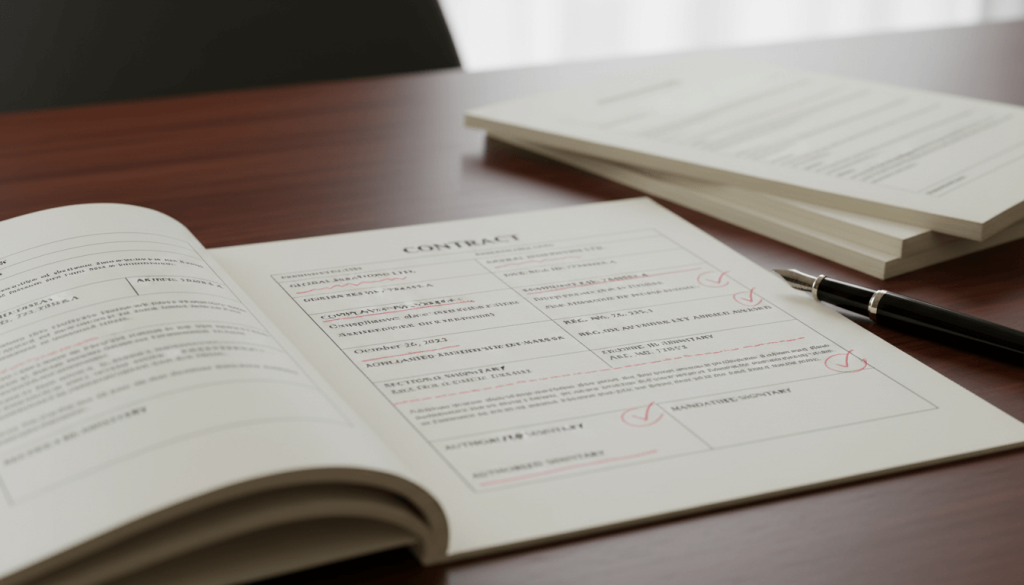
A strong companies house translation guide is really an accuracy guide.
Before release, review the following:
Corporate identity checks
- Does the company name match every source document exactly?
- Does the registration number remain identical throughout?
- Are legal form labels consistent?
- Are old and new company names handled correctly where there has been a name change?
Governance checks
- Are director powers translated consistently?
- Are quorum rules and approval thresholds clear?
- Are shareholder and board actions distinguished correctly?
- Are amendments to articles shown as amendments, not reworded summaries?
Filing and evidential checks
- Are dates preserved in the right sequence?
- Are signature blocks complete?
- Are seals, stamps, and annotations acknowledged?
- Are attachments, annexes, and schedules all included?
Language checks
- Are legal terms translated consistently?
- Are financial terms aligned with the accounts if those are included?
- Is there any place where the translator has guessed at an acronym, authority title, or company office?
If you are assembling a multi-document corporate bundle, send everything together through the free quote form instead of commissioning each file separately. That is the easiest way to keep terminology and certification consistent.
Certified translation, notarisation, and apostille are not the same thing
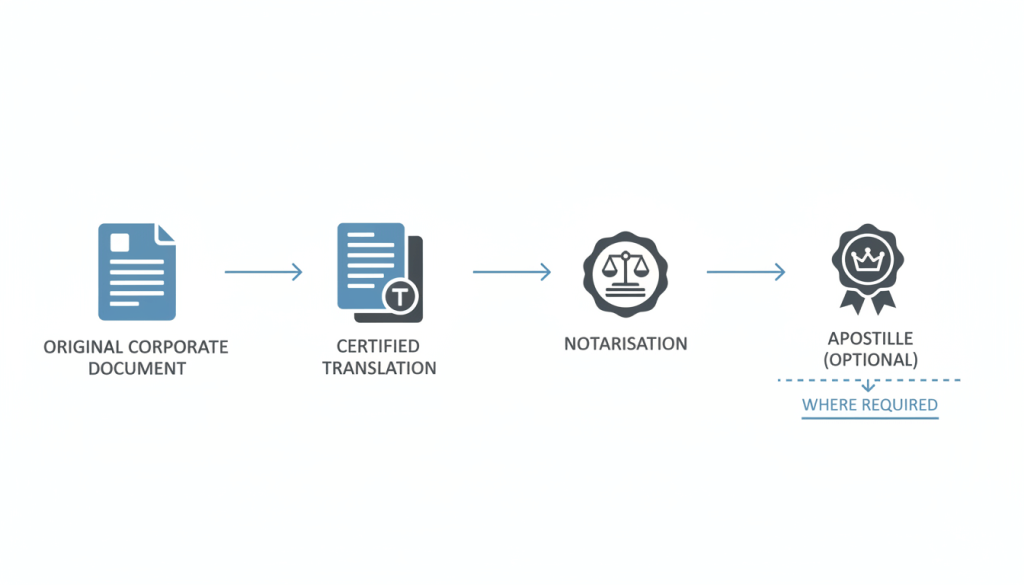
This point causes endless confusion.
Certified translation usually means the translation is accompanied by a signed statement confirming accuracy.
Notarisation usually means a notary has certified the signature or formal declaration process.
Apostille is a legalisation step used for international acceptance in Hague Convention countries.
For Companies House material, this distinction matters because a foreign authority might ask for:
- a certified copy from Companies House
- a certified translation of that document
- legalisation through the FCDO
- further embassy or consular attestation in some jurisdictions
The FCDO says certain public documents, including company certificates issued by Companies House, can be legalised, and Companies House says a certified certificate or certified copy may be required where an original British public official signature is needed for legalisation. (GOV.UK)
A better way to prepare a corporate translation pack
Here is the most efficient sequence.
- Confirm the recipient country and recipient type.
- Order the correct source documents first.
- Translate the full pack, not just the certificate.
- Run cross-document accuracy checks.
- Add the right certification wording.
- Arrange notarisation or apostille only if required.
- Deliver a filing-ready PDF set plus editable versions if needed.
This approach is faster in practice because it prevents the second and third rounds of “one more document” that usually create delays.
Example: what a well-prepared pack looks like
A UK company opening a branch overseas may need:
- certificate of incorporation
- articles of association
- board minutes approving the branch opening
- board minutes approving the authorised signatory
- certificate with certified facts or summary statement
- power of attorney
- latest accounts, if requested by the foreign authority
The most common failure point is not the translation of one clause. It is inconsistency between documents. One director middle name omitted on the resolution, a different company style on the certificate, or a mismatch between the articles and the power of attorney is often enough to trigger more questions than the translation itself.
Common mistakes that slow corporate projects down
- sending scans with cropped seals or missing final pages
- translating only the certificate when the recipient needs the full constitutional pack
- assuming certified translation automatically includes notarisation or apostille
- failing to keep company names consistent across minutes and certificates
- overlooking annexes, schedules, and shareholder resolutions
- using a translator without legal or corporate document experience
- ordering the wrong Companies House document before translation begins
What to ask before you place the order
Send these details upfront and the project moves faster:
- target country
- target language
- who will receive the documents
- whether the recipient asked for certification, notarisation, or apostille
- whether you need certified copies from Companies House first
- whether the pack includes articles, certificates, minutes, accounts, or powers of attorney
- whether you need formatting retained for side-by-side review
For corporate projects, a brief at the beginning saves more time than a rush fee at the end. If you are unsure which finish you need, use the contact page or request a free quote with the whole bundle attached.
Final word

A reliable companies house translation guide is not really about translation alone. It is about document strategy.
Articles require clause accuracy. Certificates require evidential precision. Minutes require authority and timeline consistency. When those three are handled together, your pack is easier to file, easier to legalise, easier to review, and far less likely to come back with avoidable questions.
If you are preparing articles, certificates, minutes, or a wider corporate pack for overseas use, start with the complete file set. A bundled review is almost always safer than translating one document at a time.
FAQs
Do Companies House documents need certified translation?
Sometimes yes, sometimes no. If the documents are being used in another country, the receiving authority often asks for a certified translation. If the documents are being filed with Companies House in connection with an overseas company or non-English accounts, Companies House guidance may require a certified English translation. (GOV.UK)
What documents are usually included in a Companies House translation pack?
The most common pack includes a certificate of incorporation, articles of association, board minutes, shareholder resolutions, certified facts or summary statement certificates, and sometimes accounts or powers of attorney.
Is a certified translation enough for foreign use?
Not always. Some foreign registries, banks, and authorities accept certified translation only. Others also require notarisation, apostille, or a certified copy of the original source document before translation.
Can I download a Companies House certificate and translate that?
Yes, a digital incorporation document can be downloaded from filing history if you have misplaced it. But some recipients want a certified copy or certified certificate instead of a plain downloaded copy, so confirm the requirement before you translate. (Companies House Blog)
What is the difference between a certificate of incorporation and a certificate with certified facts?
A certificate of incorporation confirms the company’s registration. A company certificate with certified facts can include extra official details, such as directors, registered office, company objects, and a summary statement if the company is eligible. (GOV.UK)
Do board minutes and shareholder resolutions need the same level of care as articles?
Yes. Minutes and resolutions often contain the approval wording that proves authority for a transaction, branch registration, bank mandate, or power of attorney. If the names, dates, or signatory roles do not match the rest of the corporate pack, the whole bundle can become harder to use.