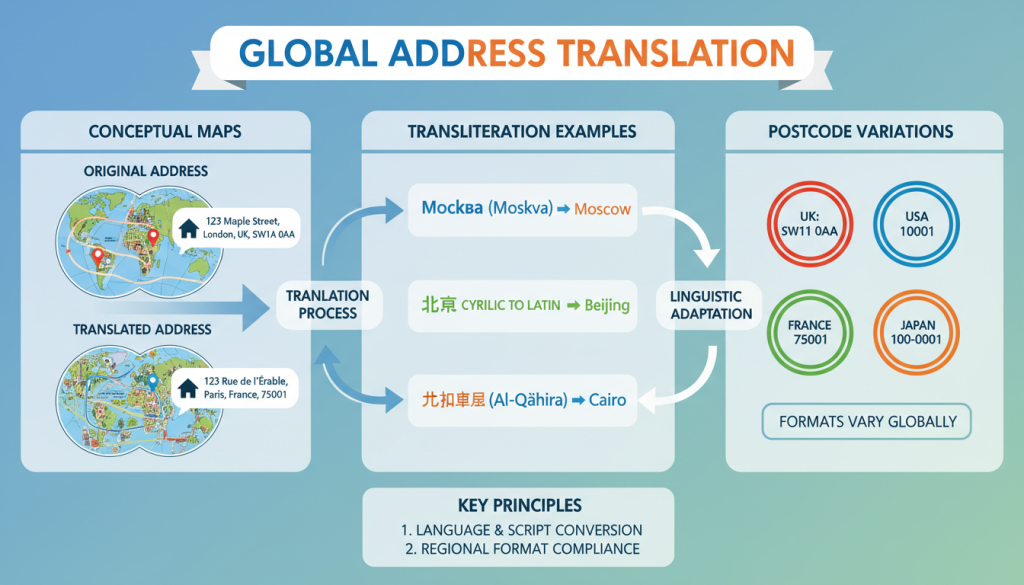
Good address translation rules
Good address translation rules are not about making an address sound elegant in English. They are about making it readable, traceable, and safe to compare against the original document.
That distinction matters more than many people realise. In certified translation, an address is rarely just descriptive text. It is an identifying data point that may be checked against passports, bank statements, tenancy agreements, utility bills, civil records, company documents, or visa paperwork. Once a translator starts “improving” that address into a cleaner English version, the risk goes up. A postcode can be altered by mistake. A local district label can be flattened into the wrong equivalent. A building number can be moved. A document reviewer can end up looking at a polished English address that no longer mirrors the source.
The safest approach is simple: preserve what identifies the location, transliterate what needs to be readable, and explain only what genuinely needs explanation. An address in a certified translation is evidence first and prose second.
If your document includes a non-Latin-script address and it will be used for a visa, legal matter, employer check, university application, or official submission, the goal is not to make the address look British or American. The goal is to make it verifiable.
Why address fields cause problems in official translations
Addresses sit in an awkward space between language and data. A person’s name can already appear in Roman characters on a passport. A date can be converted cleanly into an English format. But an address may contain:
- street names with no natural English equivalent
- local abbreviations for building, block, district, or apartment
- routing data such as postcode, zip code, delivery zone, or P.O. Box
- place names with several accepted Roman spellings
- document-specific wording that does not match what appears on maps today
That is why careless address handling creates avoidable trouble. The translation may be readable, but not matchable. And in official packs, matchability usually matters more.
A bank statement, proof of address letter, residence certificate, and passport support document do not need the translator to beautify the address. They need the translator to preserve the underlying identity of the address so the receiving authority can compare documents with confidence.
If your file pack contains multiple documents with the same address, send them together. It is much easier to keep spellings consistent across the full set when the translator can review everything at once.
Translation, transliteration and normalisation are not the same thing
This is where many mistakes begin.
Translation
Translation carries meaning from one language to another. If a source document contains a label like “Address,” “Registered office,” or “Place of residence,” that label can be translated into English.
Transliteration
Transliteration carries the sound or written form of a word from one script into another. A street or locality written in Cyrillic, Arabic, Greek, Chinese, Japanese, or another non-Latin script will often need transliteration so an English-speaking reviewer can read it.
Normalisation
Normalisation is when someone reshapes the address into a standard local format or a cleaner-looking modern version. That may be useful in logistics software. It is often risky in certified translation. A translator should not silently convert a source-document address into a different postal style, a map-style version, or a guessed English equivalent that looks more natural but weakens the link to the original.
The three-layer rule that keeps address translations safe
A reliable way to handle official addresses is to split the job into three layers.
1. Matchability
These are the elements that should usually stay exactly as they appear, apart from script conversion where needed:
- house number
- building number
- flat or apartment number
- unit number
- postcode or zip code
- P.O. Box number
- block, tower, or lot number
- document-issued Roman spelling already present in the source
These elements do the hardest verification work. They should not be guessed, reformatted for style, or “corrected” based on online searches.
2. Readability
This is where transliteration helps. Street names, neighbourhood names, districts, provinces, and cities written in a non-Latin script may need a controlled Roman-script version so the receiving authority can read them. The point is to make the source readable, not to replace it with a fresh destination-language address.
3. Clarification
This is where translator notes come in. If a local abbreviation or administrative term would confuse the reader, a short note can help:
- [district]
- [apartment]
- [building]
- [microdistrict]
- [rural settlement]
Used well, translator notes explain the address without rewriting it.
The “do not normalise” rule in practice
Here is the core principle:
Do not rewrite the address into the format you wish had appeared on the document
That means:
- do not reorder lines just to match UK address style
- do not insert missing elements from Google Maps or other websites
- do not swap a source spelling for a cleaner modern spelling because it “looks better”
- do not replace a document’s locality term with a rough English equivalent unless that choice is justified and consistent
- do not add a postcode that is not visible on the source
- do not remove a postcode because it seems unnecessary
- do not respell a place name differently across documents in the same pack unless the source documents themselves differ
A translation is not the place to repair the source document. If the original contains an old spelling, a legacy district term, or an unusual abbreviation, the translator’s job is to represent it faithfully and, where necessary, explain it. It is not to quietly modernise it.
Postcode handling: the part that should almost never change
Postcodes, zip codes, and routing codes are high-risk elements. They are not decoration. They are routing data. So the safest rule is:
Keep the postcode exactly as shown on the source document
That includes:
- the same letters and numbers
- the same sequence
- the same internal spacing if it is part of the visible source format
- the same hyphens or separators where relevant
- the same relationship to the town or city line where that matters
What should not happen:
- converting a foreign postal code into a UK-style postcode shape
- adding spaces because English formatting “looks right”
- removing spaces because the source country often writes the code differently
- replacing the code with a newer code found online
- translating a routing code label but altering the code itself
The same logic applies to P.O. Boxes, building numbers, and unit identifiers. A translator may translate the label if helpful, but the number itself must remain exact. If the address includes both a transliterated street line and a postal code, the postal code is usually the least negotiable part of the whole address.
What to keep, what to transliterate, what to explain
Keep exactly as shown
- flat, unit, lot, suite, or apartment numbers
- building, block, tower, or house numbers
- postcode, zip code, or delivery code
- P.O. Box numbers
- alphanumeric identifiers
- company registration style references inside an address line
- any Roman-character spelling already printed on the document
Transliterate carefully
- street names in non-Latin script
- district and neighbourhood names
- town and city names when no Roman-script version is already present
- province, region, or municipality names
- road-type words only where needed for readability
Explain with a note when necessary
- local abbreviations that would otherwise be unclear
- document-specific shorthand
- administrative units with no neat English equivalent
- legacy or uncommon place terms
- ambiguous handwritten additions
A good translator note is brief and useful. A bad translator note overwhelms the address and turns a simple line into commentary.
When a direct English equivalent is risky
Some words look easy to translate, but can create trouble. “District,” “region,” “county,” “settlement,” “ward,” “commune,” “prefecture,” and similar terms are not always exact equivalents across legal systems. A translator who picks the nearest English word too confidently can make the address sound smoother while making it less exact.
In those cases, a cautious approach is better:
- transliterate the local term
- keep the identifying number or name
- add a short note only if the reader would otherwise be lost
That preserves the original structure without pretending different administrative systems are interchangeable.
What about places with an established English spelling?
Sometimes a place already has a well-known English form. That can be acceptable, but consistency matters more than elegance. If one document in the pack already uses a recognised English spelling and the others clearly refer to the same place, consistency may support clarity. But mixing forms carelessly can create avoidable doubt.
For example, using one spelling for a city in one document and a different Romanised spelling in another may look minor to the translator and major to the reviewer. The safest rule is this:
Choose a traceable form and use it consistently across the pack unless the source documents require you to preserve a real difference
And if the documents genuinely differ, let that difference remain visible rather than forcing artificial harmony.
Translator notes: when they help and when they hurt
Translator notes are especially useful in address translation when the source contains compressed local shorthand. They work best when they do one of three things:
- explain an abbreviation
- identify an administrative term
- clarify that a spelling is transliterated rather than translated
They work badly when they:
- repeat obvious information
- clutter every line
- introduce facts not visible on the document
- turn the address into a mini essay
A clean note might look like this:
“kv.” [apartment]
“raion” [district]
“mkr.” [microdistrict]
That is enough.
Worked examples
Example 1: Non-Latin-script residential address
Safer treatment: Transliterate the street and locality names, preserve the building and flat numbers exactly, keep the postcode untouched, and add a brief note only if the abbreviations are not self-explanatory.
Risky treatment: Rewrite the whole line into polished English, expand every element into guessed equivalents, and reorder the address into UK house-number-first style.
Example 2: Bank statement with a partly Roman-script address
Safer treatment: Keep any Roman-script spelling already printed by the issuing bank, then translate or transliterate the remaining source-language parts around it consistently.
Risky treatment: Replace the bank’s visible Roman spelling with a different spelling because another version appears online.
Example 3: Company document with a registered address
Safer treatment: Preserve legal identifiers, registration-style numbering, building references, and office or suite numbers exactly. Translate the document labels, not the address into a new corporate format.
Risky treatment: Shorten the address, modernise it, or convert it into a “cleaner” version taken from a website footer.
The biggest mistakes to avoid
1. Searching the address online and inserting the “correct” version
That creates a translation of a different source.
2. Harmonising spellings across documents without evidence
A neat-looking pack is not the same as an accurate pack.
3. Treating the postcode like punctuation
It is not optional styling. It is core data.
4. Translating local address terms too aggressively
Not every address component has a reliable one-word English twin.
5. Ignoring the submission context
A tenancy agreement for a visa pack may need different presentation choices from a courier label or marketing database.
How to make a proof-of-address translation safer from the start
Clients can reduce delays by sending three things together:
- the full document, not a cropped address box
- any related document showing the same address in Roman characters
- the name of the receiving authority or application type
That helps the translator decide:
- whether transliteration is enough
- whether a short translator note is needed
- whether consistency needs checking across a wider file pack
- whether any spelling already appears in a passport, bank record, or prior English-language document
If your submission includes bank statements, utility bills, tenancy agreements, residence certificates, or employer letters, send the full set in one go. Address consistency is much easier to control at pack level than page by page.
The simplest rule to remember
If you remember only one point, make it this:
Do not make the address prettier. Make it checkable.
That is what strong address translation rules are really about. A submission-ready translation should let a caseworker, solicitor, admissions officer, employer, or registrar follow the address back to the original with as little friction as possible. The more an address has been normalised, polished, guessed, or modernised, the harder that becomes.
If your address appears in Arabic, Cyrillic, Greek, Chinese, Japanese, Korean, Hebrew, Thai, or any other non-Latin script, send a clear scan and tell us where the document will be submitted. We will confirm the safest treatment before work starts, keep the identifying elements intact, and deliver a translation you can use with confidence.
Send the file, the target language, and the receiving authority today, and get the address handled properly before a small formatting choice becomes a bigger submission problem.
FAQ Section
What are the most important address translation rules for official documents?
The most important address translation rules are to preserve identifying data exactly, transliterate non-Latin-script place names carefully, keep postcodes unchanged, and use short translator notes only where they genuinely improve clarity.
Should a translator keep the original address in a certified translation?
Yes, in the sense that the translation should preserve the address as documentary evidence. The translator may transliterate or explain parts of it, but should not rewrite it into a different address that no longer mirrors the source.
Do postcodes need to be translated in address translation?
No. Postcodes, zip codes, delivery zone numbers, P.O. Box numbers, and unit references should normally stay exactly as shown on the source document.
What is the difference between transliteration and translation in an address?
Translation transfers meaning into another language. Transliteration converts the script so the original wording can be read in Roman characters. For address fields, transliteration is often safer than full semantic rewriting.
When should translator notes be used in address translation?
Translator notes should be used when a local abbreviation, administrative unit, or address shorthand would otherwise be unclear to the reader. They should be short, precise, and never used to introduce information that is not visible on the source.
Can a translator normalise an address so it looks more natural in English?
That is usually the wrong approach for certified or official document work. A natural-looking English address may be less verifiable than a faithful transliterated version with a minimal note.