If you are trying to work out the right apostille and translation order, the most important thing to know is this: there is no single sequence that fits every country, authority, or document. For many overseas submissions, the safest route is to apostille the document first and then translate the full apostilled set. But in some cases, the translation needs to be prepared, certified, notarised, or checked earlier in the process. The right order is the one the receiving authority will accept the first time.
That distinction matters. A small sequencing mistake can mean paying twice, repeating a notary appointment, redoing a translation, or missing a visa, court, university, or company filing deadline. The aim is not simply to get the document translated and legalised. The aim is to get it accepted without delay.
At 24 Hour Translation, we help clients avoid that confusion by reviewing the document type, destination country, and receiving authority before work starts. That way, the translation is prepared in the right format and the legalisation steps happen in the right order.
The short answer most people actually need
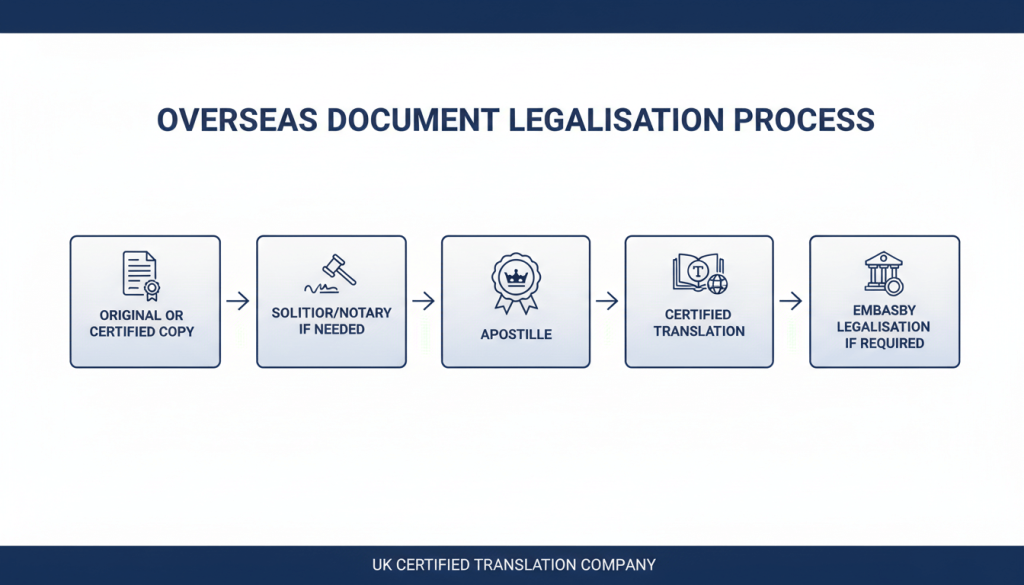
In many UK cases, the practical order looks like this:
- Confirm what the overseas authority wants.
- Check whether you are using an original public document or a certified copy.
- Get any required certification or notarisation done first.
- Obtain the apostille.
- Translate the final apostilled document, including the apostille page if required.
- Complete any additional embassy or consular legalisation if the destination asks for more than an apostille.
That is the safest default for translating apostilled documents because the translator works from the final, stamped version rather than an earlier draft of the document pack.
The best order is not the fastest order. It is the order the receiving authority will accept the first time.
Why the order changes from case to case
People often search for a universal answer, but the correct order depends on three moving parts:
1. What kind of document you have
Some documents are public documents in their own right, such as birth certificates, marriage certificates, death certificates, court documents, and certain official police or registry records.
Others are not immediately apostille-ready in their current form. Examples include passport copies, driving licence copies, powers of attorney, contracts, qualification copies, and many commercial papers. These often need a solicitor or notary step before legalisation.
2. Who will receive it
A university, civil registry, overseas employer, immigration department, company registry, embassy, or court may each ask for a different presentation format. One authority may accept a certified translation of the apostilled original. Another may want a notarised translation. Another may want the apostille on the translator’s signature rather than on the source document. Another may ask for embassy legalisation after the apostille.
3. Whether the destination only needs an apostille or needs further legalisation
An apostille is often enough for overseas use in Hague Convention destinations. But some countries or specific authorities may require extra consular or embassy steps. That changes the sequencing because you may need translation before or after the embassy stage depending on the destination’s practice.
The three safest routes
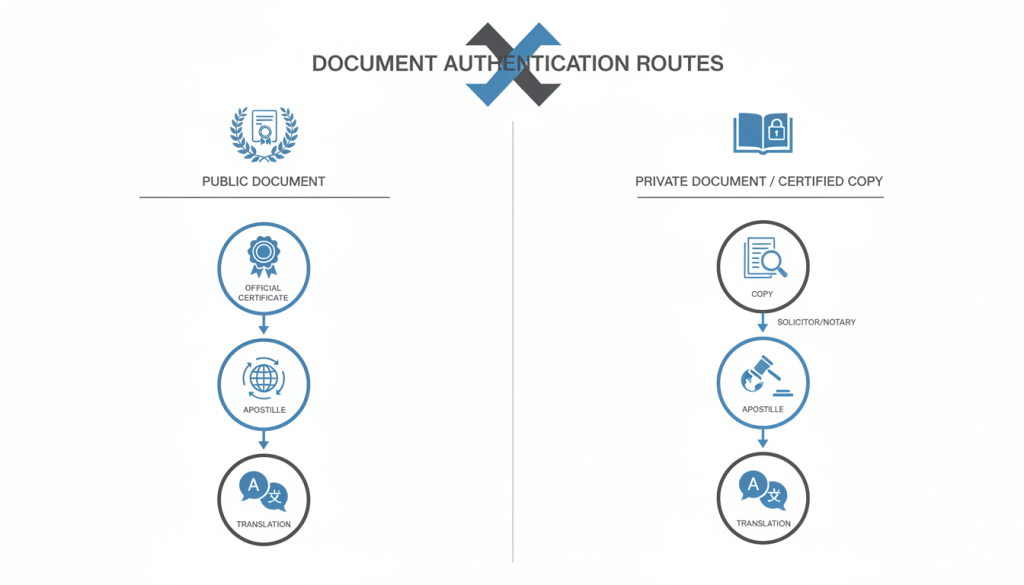
A simple way to understand apostille and translation order is to sort your case into one of these three routes.
Route 1: UK public document for a Hague Convention country
This is the route most people mean when they ask whether translation comes before or after apostille.
Typical examples:
- Birth certificate
- Marriage certificate
- Death certificate
- Court order
- ACRO or similar official certificate
- Official company certificate issued in the correct form
In many of these cases, the safest order is:
- Use the correct original or official version.
- Obtain the apostille.
- Translate the full apostilled document.
- Certify the translation if the receiving authority asks for certification wording.
Why this works well:
- The translation matches the final submission pack.
- The apostille page itself can be translated if needed.
- There is less risk of the authority saying, “You translated the wrong version.”
Route 2: Certified copy or private document
This route is often missed.
Typical examples:
- Passport copy
- Driving licence copy
- Degree copy
- Contract
- Power of attorney
- Articles or business papers signed privately
- Supporting documents that are not already public records
In these cases, the real first step is often not apostille or translation. It is certification or notarisation of the underlying document or copy.
The sequence often becomes:
- Prepare the correct original or copy.
- Have the copy or signature certified if needed.
- Obtain the apostille on that certified or notarised layer.
- Translate the final apostilled pack.
This is where many avoidable delays happen. People pay for translation first, then discover the authority wants the apostille attached to a notarial certification page that was not part of the translated set.
Route 3: Destination-specific translation or non-Hague legalisation route
This is the route for:
- Sworn translation jurisdictions
- Authorities that insist on a translator with a particular status
- Countries asking for embassy legalisation after apostille
- Corporate or legal submissions with strict formatting or binding requirements
In this route, the order can change because the receiving authority may care about who translates, how the translation is certified, and what gets legalised at each stage.
The safest approach here is not to guess. It is to confirm:
- whether the translation must be done before or after apostille
- whether the apostille should apply to the source document or the translation certification
- whether embassy legalisation follows the apostille
- whether every page, attachment, seal, stamp, and note must be translated
The practical rule that avoids most delays
If you want one working rule for most overseas use, use this:
Apostille first, then translate the final apostilled set — unless the receiving authority has clearly told you to do otherwise.
That rule is powerful because it prevents the most common problem in translating apostilled documents: the translation does not cover the apostille itself, the certification page, or the final document arrangement.
It also helps where:
- the apostille adds a page or attachment
- the document has to stay in one collated set
- the authority wants every visible element translated
- the translator must reproduce seals, signatures, and layout notes accurately
What should be translated in an apostilled pack?
Many people assume only the original document needs translation. That is often where problems begin.
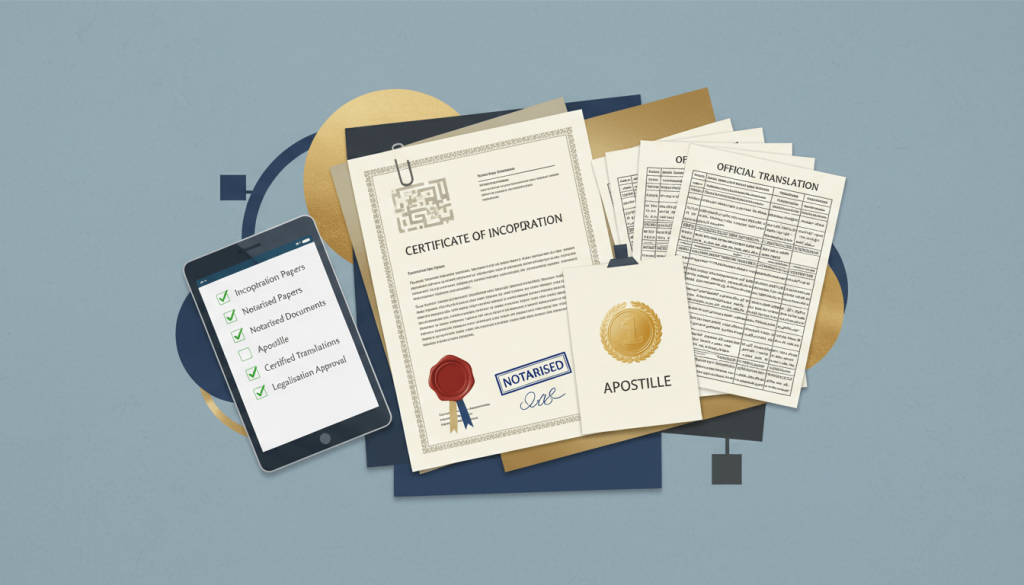
A complete overseas-ready pack may include:
- the source document
- stamps and seals on the source document
- handwritten notes where relevant
- the apostille certificate
- any certification page
- any notarial wording
- any exhibit sheet or cover certificate attached to the document
If the receiving authority wants a full translation, leaving out the apostille page can trigger rejection even though the source document itself was translated properly.
A simple decision check before you spend money
Before ordering anything, ask the receiving authority these five questions:
- Do you want the original document, a certified copy, or either?
- Do you need only an apostille, or also embassy legalisation?
- Should the translation be completed before or after apostille?
- Do you need the apostille page and all certifications translated as well?
- Do you require a certified, sworn, or notarised translation format?
That five-point check can save days of delay and the cost of redoing work.
Typical scenarios and the correct sequence
Birth certificate for marriage, citizenship, or civil registration abroad
In many cases, the safest route is:
- use the correct official certificate
- apostille the certificate
- translate both the certificate and apostille
- certify the translation if the destination asks for that wording
This works especially well where the overseas registrar wants a final pack showing both authenticity and language accuracy.
Passport copy or driving licence copy for overseas administration
A copy of the document is often not enough on its own. The authority may want:
- a certified true copy
- a notarial certification
- apostille on the certification layer
- translation of the full collated set
The mistake here is translating the copy first and only later discovering that the legalised version includes extra certification pages not covered by the translation.
Degree certificate or academic papers for employment abroad
Academic documents often split into two categories:
- original public or institution-issued records
- copies or supporting documents that need certification first
Some employers or licensing bodies want:
- apostille on the original academic document where possible
- translation of the apostilled document
- additional legalisation if the destination is outside the apostille-only route
Company documents for overseas filing
Corporate work is often more technical than personal document work.
The authority may ask for:
- certified Companies House documents
- notarised company resolutions
- apostille on the corporate or notarial layer
- certified translation of the final legalised set
- embassy legalisation for certain jurisdictions
This is one of the best examples of why a blanket answer does not work. The correct legalisation steps depend on the exact document and filing authority.
The most common mistakes that create avoidable delays
Translating too early
If a translator works from a version that later receives an apostille, solicitor certification, notarial page, or embassy stamp, the translated set may no longer match the final submission pack.
Ignoring the apostille page
Some authorities want the apostille translated too. If it is left out, the pack may be treated as incomplete.
Using the wrong base document
An old certificate, photocopy, scan, or unofficial reprint may not be the document the authority expects.
Assuming every country follows the same rule
Even when two countries both accept apostilles, the receiving authority may still have its own translation format preferences.
Forgetting the non-Hague issue
Some destinations require more than an apostille. If embassy legalisation is needed, the order and formatting should be checked before translation starts.
Breaking the document set apart
Where documents are stapled, sealed, or collated, removing attachments can cause confusion or questions about integrity. The translation should reflect the final pack as submitted.
The smarter way to plan the FCDO apostille process with translation
The FCDO apostille process is only one part of the journey. From a client point of view, the real job is building a submission pack that is accurate, complete, and acceptable abroad.
A safer planning sequence looks like this:
- Identify the destination country and receiving authority.
- Confirm the document type and whether it is already apostille-ready.
- Check whether a notary, solicitor, or certification step is needed first.
- Confirm whether a paper apostille or digital route is acceptable.
- Decide whether the translation should follow apostille or form part of a later legalised set.
- Prepare the certified translation of the final version.
- Review the pack before submission so nothing visible has been left untranslated.
That is how you avoid the classic “nearly correct” pack that gets rejected for one missing page, one missed stamp, or the wrong order.
Why clients often prefer a joined-up service
When apostille and translation are handled separately without coordination, there is more room for error:
- the wrong version gets translated
- the legalised document changes after the translation is finished
- the translator does not see the apostille page
- the client is left to guess whether the authority needs certification, notarisation, or both
A joined-up workflow reduces those gaps. You send the document, the destination country, and the receiving authority, and the order is checked before the work begins.
If you are facing a deadline, that matters more than ever. Fast service is useful only when the document is also prepared correctly.
A practical rule for avoiding double costs
Never order translation on its own until you know whether any of the following will be added later:
- apostille
- notarial wording
- solicitor certification
- embassy legalisation page
- additional exhibit or certification sheet
If something is still likely to be added, wait until the document path is confirmed. That one decision alone prevents a lot of duplicate work.
When to get help
If you are unsure, do not ask only, “Do I need an apostille?”
Ask:
- What exact format does the overseas authority want?
- What is the correct apostille and translation order for this specific document?
- Will the apostille page also need translation?
- Does this destination require only apostille, or more legalisation steps after that?
If you want certainty before paying for a notary, apostille, or translation, send the document type, destination country, and receiving authority. We can check the likely order and prepare the pack in the format most likely to be accepted first time.
Send your file today and we will review the safest route before work starts, so you do not lose time repeating steps that could have been avoided.
Frequently Asked Questions
Do I translate a document before or after apostille?
For many UK public documents, the safest route is to apostille first and then translate the final apostilled set. That allows the translator to include the apostille page and any attached certification. However, some authorities want a different sequence, so the receiving body should always be checked first.
Can I translate an apostilled document without translating the apostille itself?
Sometimes, but it is risky to assume. Many overseas authorities expect the apostille certificate and any attached certification wording to be included in the translation. Leaving it out can make the pack look incomplete.
Does the FCDO apostille process confirm that the translation is accurate?
No. The apostille is about official authenticity, not translation quality. The translation still needs to be prepared in the format the receiving authority accepts, whether that is certified, sworn, notarised, or otherwise formally presented.
What if my document is a passport copy, driving licence copy, or private document?
These often need a certification or notarial step before apostille. In those cases, the correct order is usually certification first, then apostille, then translation of the final legalised pack.
Do all countries accept the same apostille and translation order?
No. Even where apostilles are accepted, the receiving authority may have its own rules about copies, translator status, notarisation, or whether the apostille page must be translated.
What is the best way to avoid delays?
Confirm the receiving authority’s exact requirements before ordering. Ask whether they want the original or a certified copy, whether they need only apostille or further legalisation, and whether the full apostilled set must be translated.